

I Switched From Fzf to Television: Declarative Channels for Cross-Shell Fuzzy Finding
You may have been there:
- Tedious Navigation Loop: Endlessly typing
cd foo/ && lsjust to realize you are in the wrong directory, thencd ../..and starting over. - The History Searching: Repeatedly pressing the Up arrow to find a complex command you ran yesterday.
- The PID Dance: Running
ps aux | grep pythonto locate a python process, copy the Process ID(PID) and then manually typing it intokill
Fuzzy finders like fzf address this issue, but I switched to Television since it offers better UI/UX and cross-shell consistency.
This post is for terminal users who want to navigate faster without maintaining shell-specific glue code. By the end, you will understand how fuzzy finder works, how to setup tv, and whether it fits your workflow better than what you are using now.
Fuzzy Finder
Imagine you need to find a subdirectory somewhere in your project. You could use fd --type directory to list them all:$ fd --type directorysrc/...packages/core/utils/src/helperspackages/core/utils/src/parserspackages/ui/components/Button
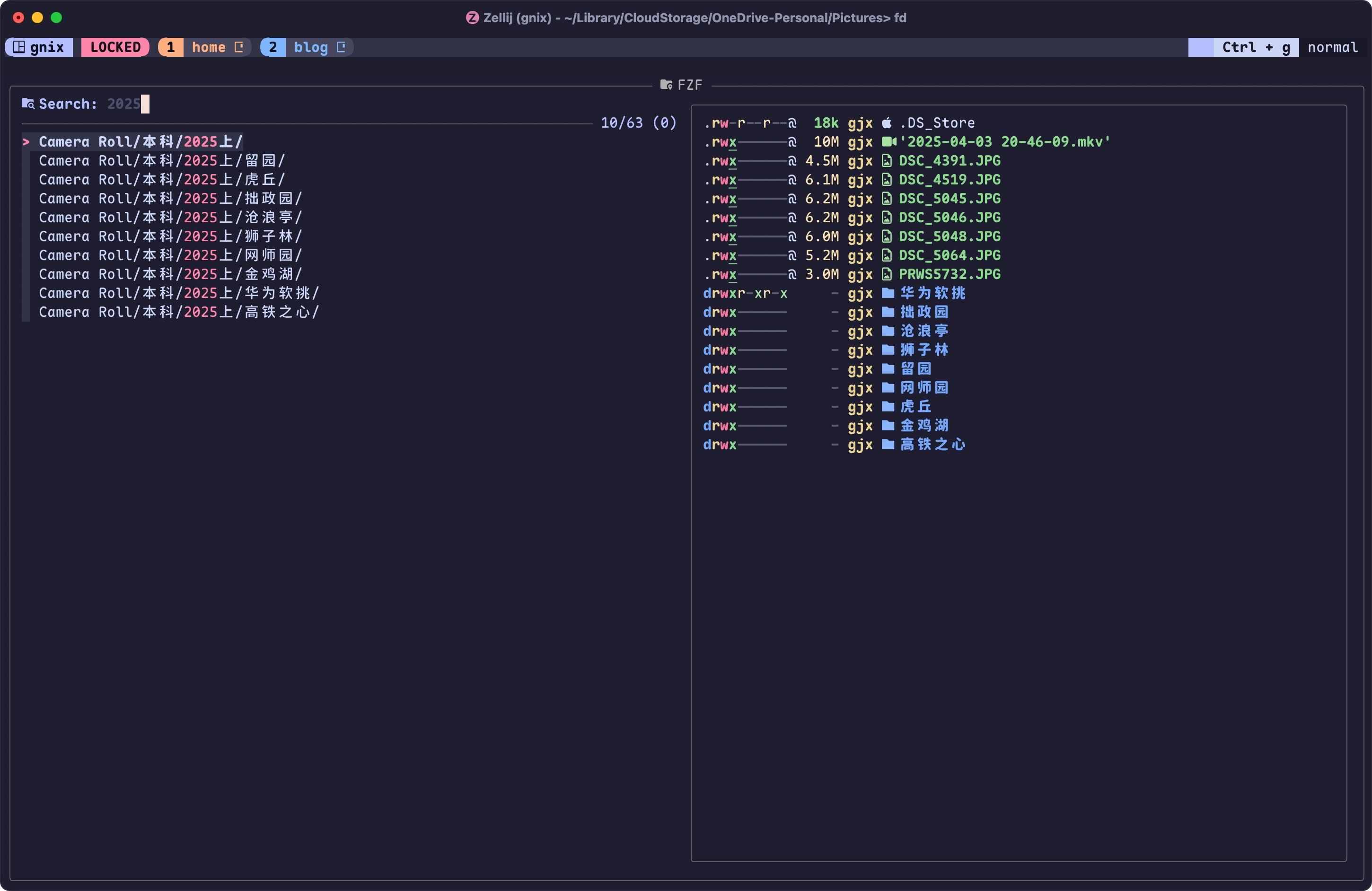
Scanning through a long list to find the right path is painful. You can use fd --type directory | rg <src> to narrow down the results—but it’s still a static list. This is where fuzzy finders shine:fd --type directory | fzf --preview 'eza --all --git --long --no-time --color=always --icons {}'
Pipe the output to fzf and you get an interactive filter with a preview pane:
What Happens Underhood
When you execute the pipeline, fd begins scanning immediately. Crucially, fzf doesn’t block waiting for fd to finish.
It uses a streaming architecture: as soon as fd emits a path to stdout, fzf grabs it from stdin and populates the list in real-time. This is why the UI loads instantly, even while fd is still churning through thousands of files in the background.
The --preview flag transforms fzf from a simple text filter into a command orchestrator.
- Dynamic Substitution The
{}placeholder is the key. As you traverse the list,fzfdynamically swaps{}with the currently highlighted path (e.g.,packages/ui). - Subprocess Execution For every cursor move,
fzfspawns a temporary shell process to execute the constructed command (eza ... packages/ui). - ANSI Passthrough Since we forced
--color=always,ezaoutputs raw ANSI escape codes.fzfacts as a mini terminal emulator here, capturing those codes and faithfully rendering the colors and icons in the side panel.
You might wonder: “If I scroll down quickly, will it spawn 50 instances of eza in a second?”
Smartly, fzf employs a debounce mechanism. If you scroll fast, it holds off on spawning the preview command until the cursor settles for a fraction of a second. It also aggressively kills any stale eza processes from previous selections to prevent your CPU from melting.
Once you find the directory you need and press Enter, fzf terminates, closes the eza preview, and prints the selected path to standard output.
This is the essence of the Unix philosophy. Because fzf sends clean text to stdout, you can compose it with other commands—like jumping into that directory automatically:
cd $(fd --type directory | fzf ...)
Integrate it with Your Shell
The real power comes from integrating fuzzy finders into your shell workflow. Press Ctrl + T mid-command, select a file or directory, and the result inserts directly at your cursor. No typing paths, no copy-pasting.
Setting this up requires shell-specific glue code if you’re not using bash, zsh or fish(they have official support). Here is how Nushell handles it with commandline edit:{ name: fuzzy_file modifier: control keycode: char_t mode: [emacs, vi_normal, vi_insert] event: { send: executehostcommand cmd: "commandline edit --insert (fd --type file | fzf --preview 'eza --all --git --long --no-time --color=always --icons {}')" }}
From Fzf to Television
So you have seen how fzf works. It is powerful, but integrating it across different shells requires shell-specific glue code. I mainly use nushell on my Windows & macOS laptop, but sometimes I use zsh or bash just for fun. If use fzf, I have to maintain different configurations.
Television (tv) tackles this complexity by solving it at the configuration layer rather than the script layer. It acts as a fast, portable fuzzy finder that guarantees a consistent experience everywhere:
- Declarative Channels: Instead of complex pipes, logic is defined in TOML-based Channels. These are easy to read, share, and version control
- Shell Integration: Configure it once in your
config.toml, and enjoy consistent behavior across bash, zsh, fish, and nushell (e.g., Ctrl + T for smart completion, Ctrl + R for history search). No manual wiring required. - Modern UX & Discoverability: It features a polished UI with a dynamic shortcut hint bar —— a game-changer for onboarding that lets you learn commands on the fly, no manual memorization needed.
Quickstart
Step 1: Install Television
Download the tv binary for your operating system:# Windows (Scoop)scoop install television# macOS (Homebrew)brew install television# Linux / Othercargo install television
Step 2: Download Channels
Run tv update-channels to download community-maintained channels. Channels are predefined search sources that tell tv what to search and how to display results.
Step 3: Shell Integration
Inject the tv startup script into your shell configuration, this script will binds two global shortcuts that integrate tv into your shell workflow:# Zshecho 'eval "$(tv init zsh)"' >>~/.zshrc# Bashecho 'eval "$(tv init bash)"' >>~/.bashrc# Fishtv init fish | source # Add to config.fish
Channel
Channels are short configuration recipes that typically dictate what tv should search through and what’s displayed on the screen along with various other options.
Channels define what tv searches and how results display. They live in ~/.config/television/cable/.
The tv update-channels command you ran earlier downloads commonly used channels from the community.$ tree ~/.config/television~/.config/television├── config.toml├── cable│ ├── alias.toml│ ├── aws-buckets.toml│ ├── aws-instances.toml│ ├── git-repos.toml│ ├── nu-history.toml│ ├── text.toml│ └── zsh-history.toml
bat and fd.shell = bash/zsh in your config.toml to avoid errors if using nushell[1] given that most community-maintained channels use posix-compatiable shell’s syntaxshell = "bash" # you can also use zsh
Enhance Your Workflow with Channel
This specific capability—smart shell integration—is the primary reason I migrated from fzf to television.
Instead of a static file search, tv intelligently detects the command currently in your buffer and triggers the appropriate channel when you press Ctrl + T. It adapts to your context:
- Editing: Typing
vimorcattriggers the files channel. - Navigation: Typing
cdtriggers the dirs channel. - Management: Typing
killorpstriggers the procs channel.
[shell_integration.channel_triggers]"dirs" = ["cd"]"files" = ["cat", "vim"]This behavior is defined declaratively in config.toml under the [shell_integration.channel_triggers] section. You can customize these mappings to fit your workflow (Check my config.toml on GitHub for a full example):
Trade-offs to Consider
Television is not a perfect replacement for every fuzzy finder use case.
When tv makes sense:
- You switch between shells frequently and want consistent behavior
- You prefer configuration files over shell scripts
- You value the built-in channel system for common searches
When to stick with fzf:
- You have heavily customized fzf integrations you cannot easily migrate
- You are happy with your current setup and do not need cross-shell portability
The real insight here is that shell tooling fragmentation creates hidden work. Every time you customize fzf for bash, you create future work if you ever switch shells. tv attempts to solve this at the configuration layer rather than the script layer.
Read Also
Dive deeper into the full feature set in the Television documentation. I also highly recommend checking out the Unix Community Channels to preview the latest integrations built by the community.
The documentation is worth a visit just for the aesthetics; it sports a clean UI paired with the charming pixel-art Doto font.
I Switched From Fzf to Television: Declarative Channels for Cross-Shell Fuzzy Finding