---
title: Shanghai Natural History Museum
date: 2026-10-04
excerpt: "Shanghai Natural History Museum on National Day: giant rhinos, a curious lion, familiar experiments, and fossils I only understood after reading more."
updated: 2026-10-07 21:58:06
lang: en
i18n:
cn: /shanghai-natural-history-museum
translation: 2
---
I couldn’t get a ticket back to Qingdao for October 1, so I stayed in Shanghai and booked a morning ticket to the Shanghai Natural History Museum.
It was a long metro ride. Along the way, I came across a [post about listening to the rain](https://xhslink.cn/o/4x2Gi00vVRN): a teacher was discussing Jiang Jie’s “Yu Meiren: Listening to the Rain”[^tingyu] when a sudden downpour knocked the osmanthus blossoms from the trees outside. The teacher closed the door, opened the window, and said:
> “Class, I'll stop here for now. Let's listen to the rain together for a while.”
It reminded me of a visit to Nanjing Museum the day after the Mid-Autumn Festival. It had been pouring then, too, with golden petals covering the ground and the scent of osmanthus in the air. The driver who picked me up from Purple Mountain that day had even opened the window, telling me that Nanjing had a long history of growing osmanthus. When I was studying in Chengdu, there were plenty of osmanthus trees beside Teaching Building 4. Whenever I got tired of studying, I would go out and breathe in their scent.
A few more posts later, the metro reached my stop. From the station, I walked through Jing’an Sculpture Park to the Shanghai Natural History Museum. It was nearly noon by the time I arrived, but fortunately the queue was short.
## Working My Way Down from L2
I followed a route from the upper floors down, moving from the origins of the universe and life to animal specimens, Shanghai’s natural environment, and minerals. Here is a rough guide to the floors[^1]:
- L2: “Mystery of Origins.”
- L1: “River of Life.”
- B1: “Ways of Evolution” and “Road to the Future”; on the day of my visit, the temporary exhibition hall was also hosting “Deep Time: From Fish to Human.”
- B2M: “Shanghai Story.”
- B2: “Ecological Variety,” “Diversity of Life,” “Earth’s Treasures,” “Survival Wisdom,” “Humans and the Earth,” “Discovery Center,” and other exhibits.
(This floor guide was compiled with AI assistance, using exhibit names from the [official website](https://www.snhm.org.cn/cszl/virtualRoaming.htm).)
The website also offers a [virtual tour](https://www.snhm.org.cn/cszl/virtualRoaming.htm), though its design feels a little dated to me. For browsing museums online, [Google Arts & Culture](https://artsandculture.google.com/) has left me with a better overall impression.
## L2: Mystery of Origins
After having my ticket checked on L2, I entered “Mystery of Origins.” The exhibit moves from the evolution of the universe to the emergence of life, with astronomical instruments, experimental apparatus, and meteorite specimens on display.
What stayed with me most was the reconstruction of the [Miller–Urey experiment](https://zh.wikipedia.org/zh-hans/%E7%B1%B3%E5%8B%92-%E5%B0%A4%E9%87%8C%E5%AE%9E%E9%AA%8C). I had read about it in textbooks before; seeing the whole apparatus made it a little more tangible.
The results, published in 1953, showed that under certain conditions, simple molecules could form amino acids and other organic compounds through nonbiological processes. The apparatus contained methane, ammonia, hydrogen, and water. Electric sparks simulated lightning, driving reactions in the mixture of gases and water vapor.
The setup simulated what scientists at the time thought conditions on early Earth might have been like; the actual composition of its atmosphere remains a subject of debate. The experiment offered clues to how the organic molecules needed for life could form. Many questions still separate that result from an explanation of how life itself began.
## L1: River of Life
Following the curving ramp down from L2 brought me to “River of Life.”
This might be the most visually impressive hall in the museum. Huge models of a blue whale and a plesiosaur hang in the tall, open space, surrounded by sharks, jellyfish, squid, and other marine life. Along the ramp are specimens or models of Komodo dragons, birds, herbivores, and primates.
Looking down from the ramp, I could see animals of every kind arranged below. As on my visit to the [[chengdu-natural_museum__en|Chengdu Natural History Museum]], I felt as though I were aboard Noah’s Ark.
At the bottom of the ramp were bears, tigers, leopards, wolves, and two fossil displays with visible layers of rock. They must be precious to someone who knows what to look for. As an outsider, I was mostly just taking in the spectacle.
A few exhibits on this floor were especially memorable:
1. **An African lion with a rather “wise” expression.** Later, in the gift shop, I bought a basswood music box modeled after it, both as a souvenir and as a small way to support the museum. A thoughtful touch: the product also included the story behind the specimen[^2].
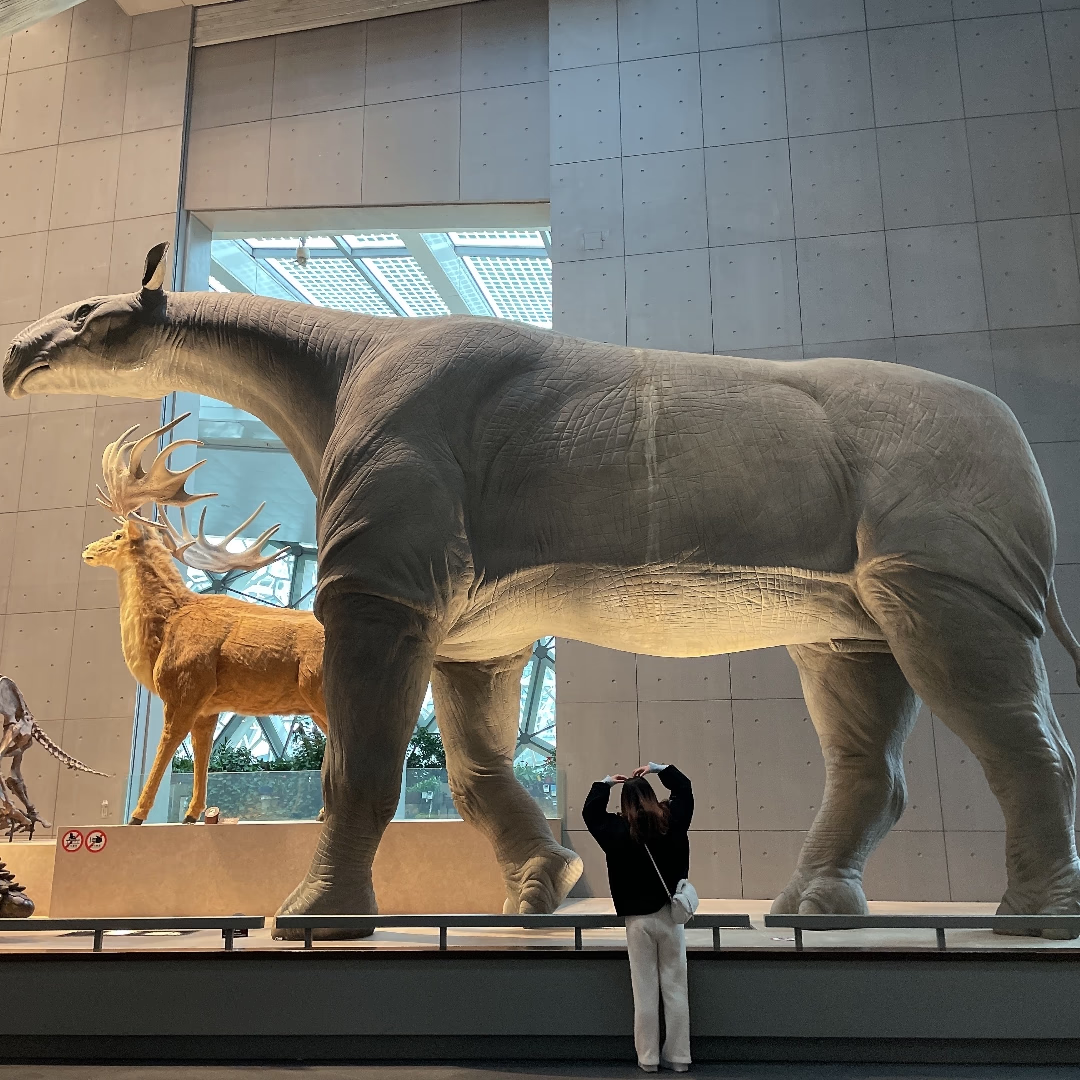
2. **A model of the giant rhino *Dzungariotherium orgosense*.** A relative of modern rhinos, it lived during the Oligocene and was among the largest land mammals ever known[^3]. I remembered its shape from illustrations in my school textbooks, so the model looked familiar.
3. **A few bears that brought a cartoon to mind.** A polar bear, a brown bear, and a giant panda stood together, making me wonder whether this was a nod to *We Bare Bears*[^4]. There was also a display of bear skeletons and mounted specimens in some rather unfortunate poses…



## B1: Ways of Evolution and Road to the Future
I took the elevator farther down. On B1, “Ways of Evolution” uses fossils and models to trace the long history of life, from the Cambrian explosion through the age of dinosaurs to the rise of mammals.
Passing the temporary exhibition hall, I spotted “Deep Time: From Fish to Human.” After hearing a security guard’s introduction, I decided to buy a separate ticket and have a look. I didn’t grasp the significance of many of the fossils while I was there; that only started to become clear when I read more afterward. I wrote about that in [[deep_time_from_fish_to_human__en|“Deep Time: From Fish to Human — Notes After the Exhibition”]].
Alongside the fossils and models of prehistoric animals, this floor has anatomical specimens showing the internal organs and muscles of animals such as horses and deer, as well as primate specimens and skulls.
“Road to the Future,” on the same floor, complements “Ways of Evolution.” What struck me most was the word “Extinction” near the exit, beside a digital screen continually updating the day’s death and birth counts. According to the numbers on the screen, the world’s population was still growing.


## B2M and B2: Shanghai Story, Animals, and Minerals
Farther down, “Shanghai Story” on B2M brings the focus back to the local area, introducing Shanghai’s natural environment and wildlife.
B2 covers more ground: displays of life from Africa, Antarctica, and the Tibetan Plateau, along with butterflies and other insects, bird specimens, and animal skins. “Diversity of Life” displays animals of all kinds, while “Earth’s Treasures” presents mineral crystals.

## Before Leaving
In the gift shop, I deliberately passed over the same old fridge magnets and chose the African lion music box and a few ornaments instead. Unfortunately, the quality was disappointing.
What stayed with me from this visit included the experiment and giant rhino I knew from textbooks, but also the lion’s expression and the way those bears were arranged. There were plenty of fossils I had simply looked at without understanding much; only after reading more at home did I begin to see what made them worth a closer look. That reading became an extension of the visit.

[^tingyu]: **“Listening to the Rain,” to the tune of *Yu Meiren* — Jiang Jie, Song dynasty**
In youth, I listened to rain in a house of song; red candles glowed dimly behind silken curtains.
In my prime, I listened to rain aboard a boat far from home: a broad river, low clouds, a lone wild goose crying in the west wind.
Now I listen to rain beneath a monk’s roof, my temples already flecked with gray.
Joy and sorrow, parting and reunion are all merciless; let the rain drip before the steps until dawn.
[^1]: L1 and L2 are Levels 1 and 2 above ground; B1 and B2 are Basement Levels 1 and 2. B2M is the mezzanine above B2, between the two basement levels.
[^2]: According to the description on the souvenir, this “cute lion” was an adult male African lion from Hangzhou Zoo. After it died in 1977, it was sent to the Shanghai Natural History Museum to be preserved as a specimen. The limitations of taxidermy techniques at the time, combined with decades of aging, gradually distorted its face, accidentally giving it this comical expression.
[^3]: For the classification, age, and size of this giant rhino, see [Dzungariotherium](https://en.wikipedia.org/wiki/Dzungariotherium). Further viewing: [A Rhino Bigger Than an African Elephant! Why Have Rhinos and Elephants Been Rivals for 20 Million Years?](https://www.bilibili.com/video/BV1xN4y1R7nz/)
[^4]: [*We Bare Bears*](https://baike.baidu.com/item/%E5%92%B1%E4%BB%AC%E8%A3%B8%E7%86%8A/60936659) is an American animated series whose three main characters are Grizzly the brown bear, Panda the giant panda, and Ice Bear the polar bear.