
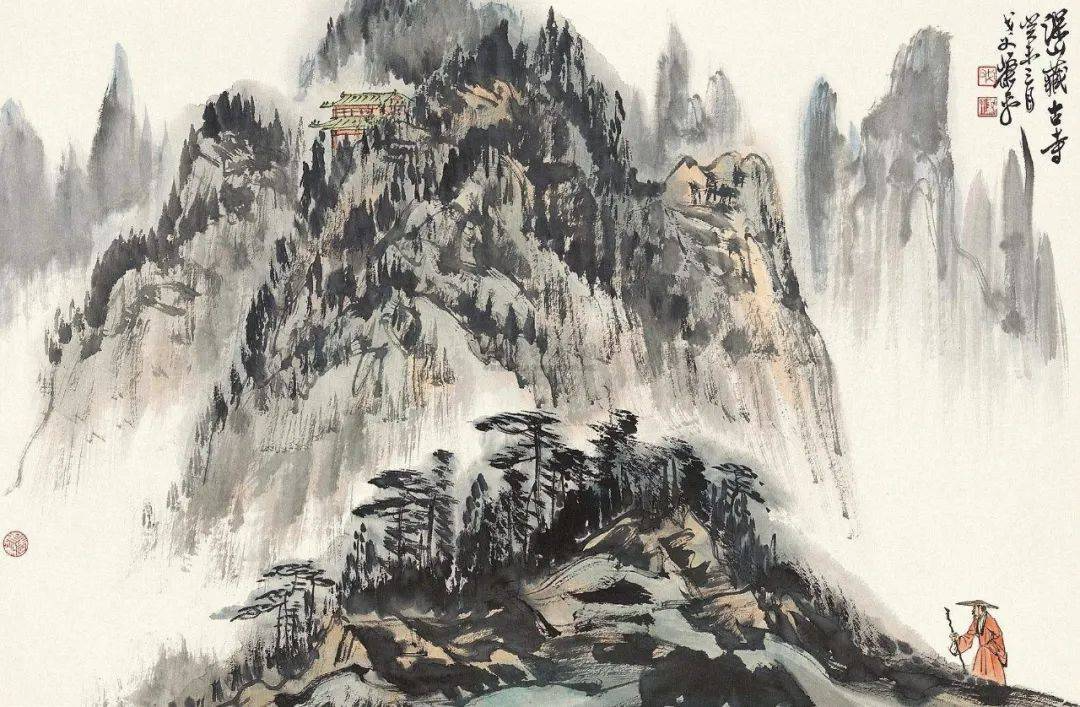
[Song] Yang Wanli
Packed side to side, the thousand mountains leave no seam;
up to the sky, down into wells, the road twists through ten thousand crags.
Yesterday I passed Furong Ferry;
following the stream, I reached the first thread of its source.
North of the mountain, the stream’s voice welcomed me all the way;
south of the mountain, its echoes saw the traveler off.
I know it flows toward Jinling;
if it passes Jinling, do not send any word.
The rear mountain reins the water eastward,
only for the front mountain to force it west.
People say water is soft and has no temper;
in its rushing voice it rages, in its slow voice it grieves.
Only when the sun climbs high does the valley floor grow faintly warm;
the emerald mountain mist is still cold enough to pierce the bones.
Tell the travelers: what are they hurrying for?
In the cry of the golden rooster, the silver saddle is urged on.
Do not say that once you descend the ridge there will be no more difficulty;
it tricks travelers into a mistaken joy.
Just as you enter the encirclement of ten thousand mountains,
one mountain lets you pass and another bars the way.
This is exactly when a traveler’s heart breaks;
the cuckoo cries to people again and again.
If its tears could wet the faces of those left at home,
only then would I believe that all spring sorrow is for it.
Notes
- Songyuan and Qigong Inn: place names, in the mountains of southern Anhui today (between present-day Yiyang and Yujiang in Jiangxi)
- Cese: packed and filled, with no open space
- Yesterday: the previous day
- Send word: ask someone to pass along a message
- Rein: constrain or hold back
- Xuan: warm
- Emerald mountain mist: green mountain haze (the phrase appears in Bai Juyi’s “Early Spring Inscribed at Shaohua East Cliff”: “When the thirty-six peaks clear, melting snow gives rise to emerald mist”)
- What matter: what thing, what reason
- Silver saddle: a saddle decorated with silver, used here to refer to a fine horse
- Just entering: exactly entering
- Cuckoo: another name for the dujuan bird. Legend says it was transformed from the soul of Du Yu, emperor of Shu. It often cries at night, with a sorrowful voice, so it is used to express grief and resentment
- Again and again: repeatedly, frequently
- Those at home: people who remain at home, here referring to the wife
- It: a third-person pronoun
Creative Background
Yang Wanli advocated resistance throughout his life and opposed surrender, so he was never given important posts. After Emperor Xiaozong of Song ascended the throne, Yang was sent out to serve as an official. In the first year of the Shaoxi era under Emperor Guangzong of Song, in the eleventh month of 1190, Yang Wanli, then holding the title of Direct Scholar of the Dragon Diagram Pavilion, was appointed deputy transport commissioner of Jiangdong and temporarily oversaw the military funds and provisions of Huaixi and Jiangdong, with his office in Jiankang, today’s Nanjing, Jiangsu. In the eighth month of the third year of Shaoxi, 1192, he was reassigned to govern Ganzhou, but he did not take the post and requested a sinecure temple office instead. In the sixth poem of Six Poems Written Passing Songyuan While Cooking Breakfast at Qigong Inn, the lines “This is exactly when a traveler’s heart breaks; / the cuckoo cries to people again and again” correspond to the line from Resting at Majia Inn, “Wearing unlined clothes and grass sandals, I try the spring wind as I do every year.” Since it says “every year,” this was likely not written in the second year of Shaoxi, but in the spring of the third year, when the poet was sixty-six. Passing Songyuan on a journey, he saw mountains surrounding him on every side and was moved to write this group of six poems.