June 10. Chengdu was cloudy, 17 to 29 degrees Celsius. Once again, I did not get up until noon.
The original plan was that if I could get up at eight, I could wander around Qingyang District a bit longer. Recently my sleep latency has always been long: I cannot fall asleep at night, get up late the next day, and after getting up late I do not spend enough time awake before bedtime, so sleepiness never accumulates. Then I continue being unable to sleep.
After waking up, I looked at my computer for a while. I had just updated to macOS 27 the night before. Its official name is Golden Gate, not the previously rumored Big Bear. The first thing I noticed after the update was that iStats Menu no longer worked.
Note from 2026-06-14: before updating macOS in the future, I really should check compatibility discussions on MacRumors first. For example, macOS 27 - working and non-working apps thread lists the status of quite a few apps on macOS 27. Some people said reinstalling iStats Menu could fix it, but it did not work for me.
I went downstairs at 12:40. I originally wanted to get a rice dish at the small stir-fry place beside Guiyuan, but the owner said they were closing, so I had to go to Jianshe Alley and eat the Neijiang beef noodles I had eaten before. While eating noodles, I was ambushed by fallen leaves and suddenly thought of the two ficus trees beside Guiyuan cafeteria.
Ficus virens is very common in Sichuan and Chongqing. Unlike trees that leaf out in spring and shed in autumn, it sheds leaves in spring. The two ficus trees in front of Guiyuan change leaves at different times, both very quickly. This semester I probably watched them go through five or six rounds of leaf replacement.
After eating, I returned to the metro station, took Line 17, and transferred to Line 13. I exited at Qingyang Palace Exit E, crossed a bridge over Modi River, a tributary of the Nanhe River. After crossing, a curio market was on the right, with some middle-aged and older people running stalls. Then I crossed the intersection, turned left onto Huanhua South Road, and continued straight toward Huanhua Creek until I reached Sichuan Museum.
Sichuan Museum
I stayed in Sichuan Museum until around 3:30. The galleries went from the pre-Qin period and Qin-Han dynasties through the Three Kingdoms, Five Dynasties and Ten Kingdoms, then connected onward to Tang, Song, Ming, and Qing. Arranging exhibits by dynasty is probably the approach most permanent exhibitions take.
After visiting exhibitions a few times, I now have some understanding of Sichuan history.
For the pre-Qin part, I had heard of Cancong and Yufu from poems such as The Hard Road to Shu. Wangdi Duyu from the same period appears even more often in classical poetry, such as Li Shangyin’s “Zhuangzi woke from a dawn dream as a butterfly; Emperor Wang entrusted his spring heart to the cuckoo.” Oh, there were also prehistoric galleries. I did not pay much attention to that part, though Anthropic’s art style does somewhat resemble the pottery style of ancient humans.
For the Qin-Han section, because I remember a little Warring States history, I could still count out figures such as Zhang Yi, Ying Si, and Ying Ji from Qin’s eastward expansion.
After that came the household-name Three Kingdoms, then Tang, Song, Ming, and Qing. Among historical figures I know from Ming-Qing history, Zhang Xianzhong, the “Great Western King,” counts as one. I learned about him on Tieba back in high school.
Heaven gives all things to man
Man gives nothing to Heaven
Kill kill kill kill kill kill kill
Inserted among those familiar dynasties and names were lesser-known regimes such as Cheng-Han and Former and Later Shu. Their level of public recognition is probably about the same as knowledge points that are “not tested on the gaokao.”
A few artifacts that left a deeper impression:
- Bronze lei vessel with elephant-head handles and animal-mask pattern
- Bronze hu vessel with water-and-land battle pattern
- Fourteen chime bells
- Money tree
- Storytelling figurine
- Jade belt plaque excavated from the Yongling Mausoleum, the tomb of Wang Jian, founder of Former Shu
- Tang dynasty Shijian Qiaobing seven-string qin
- Tang sancai camel
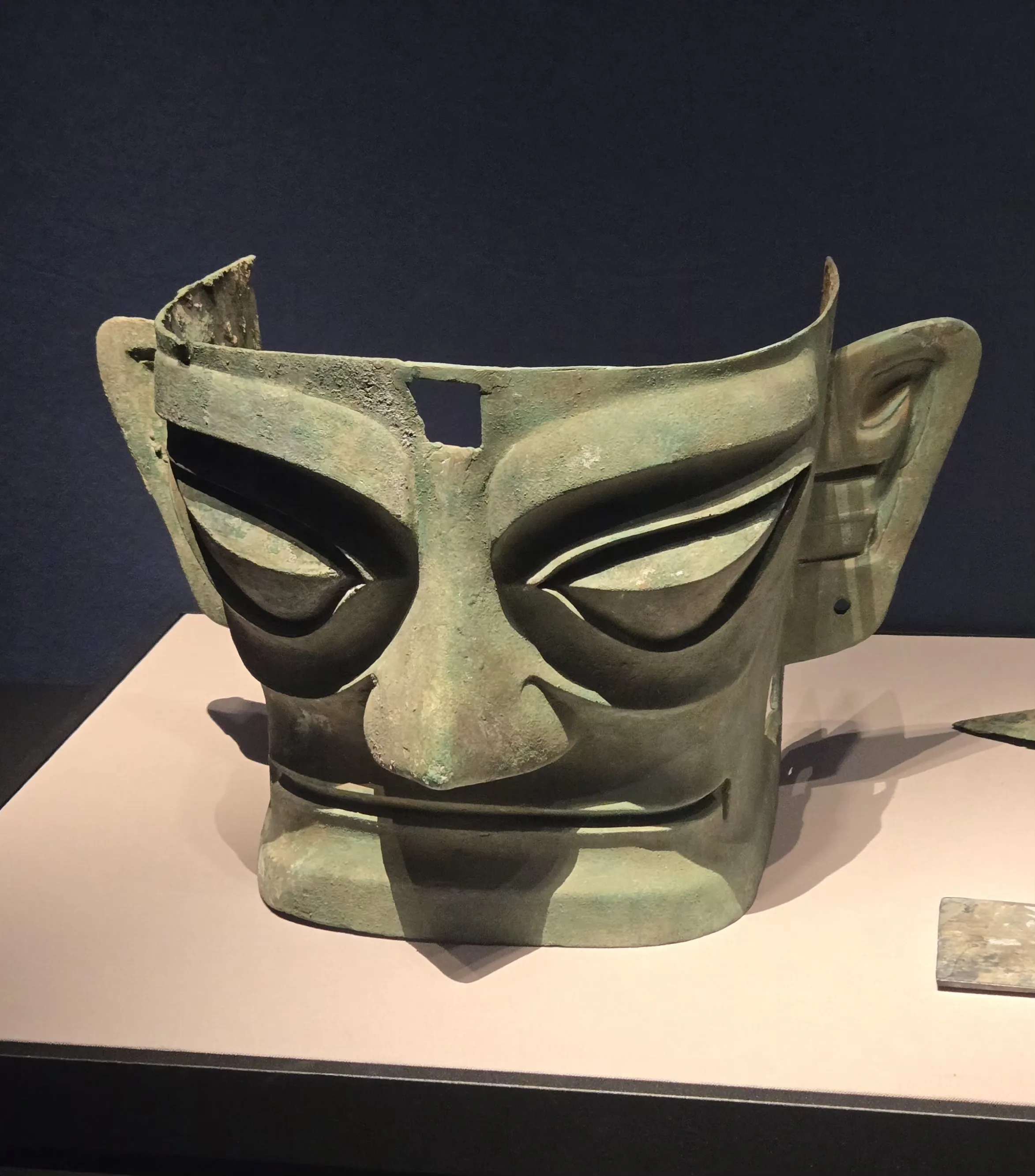
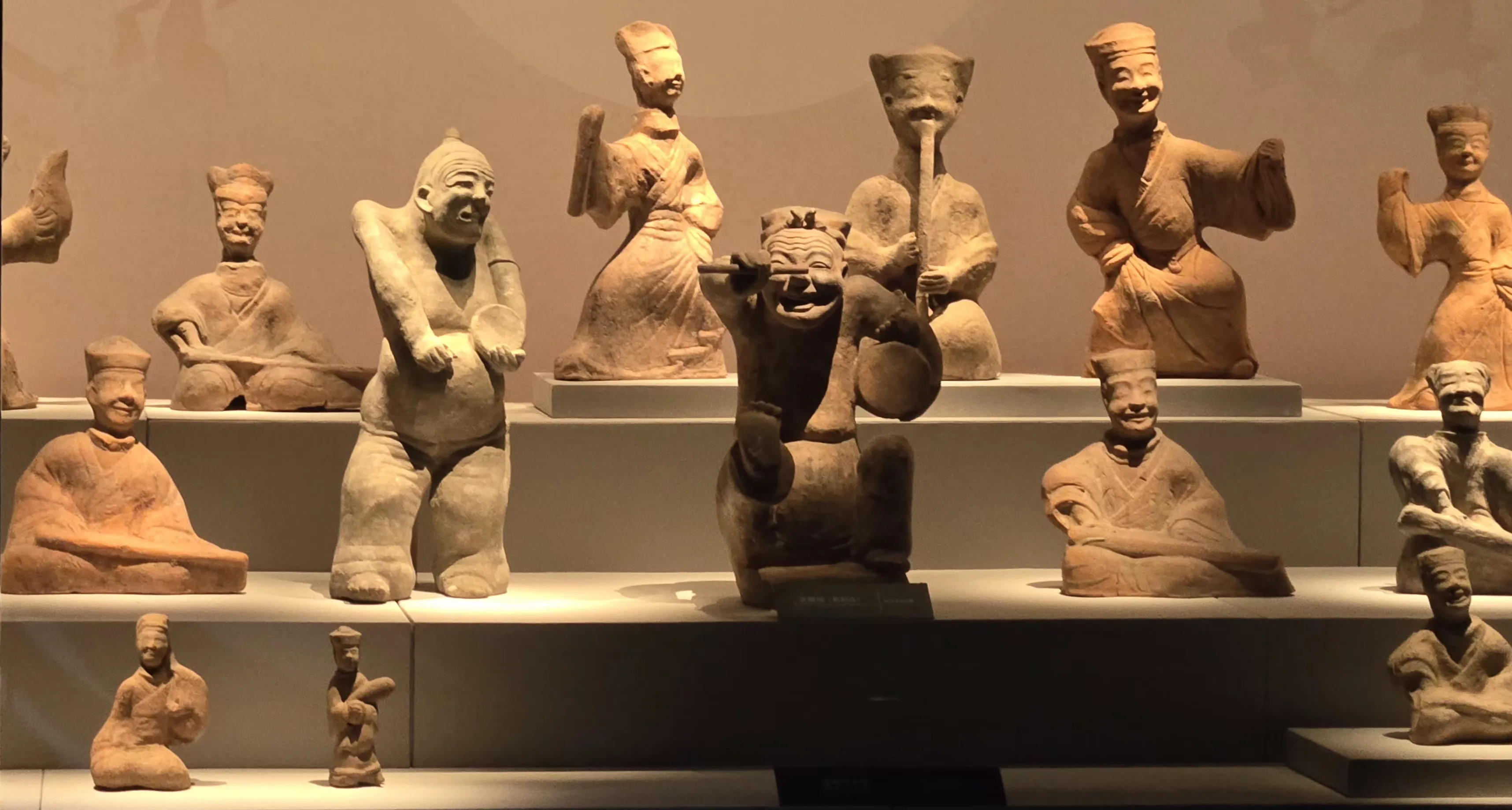
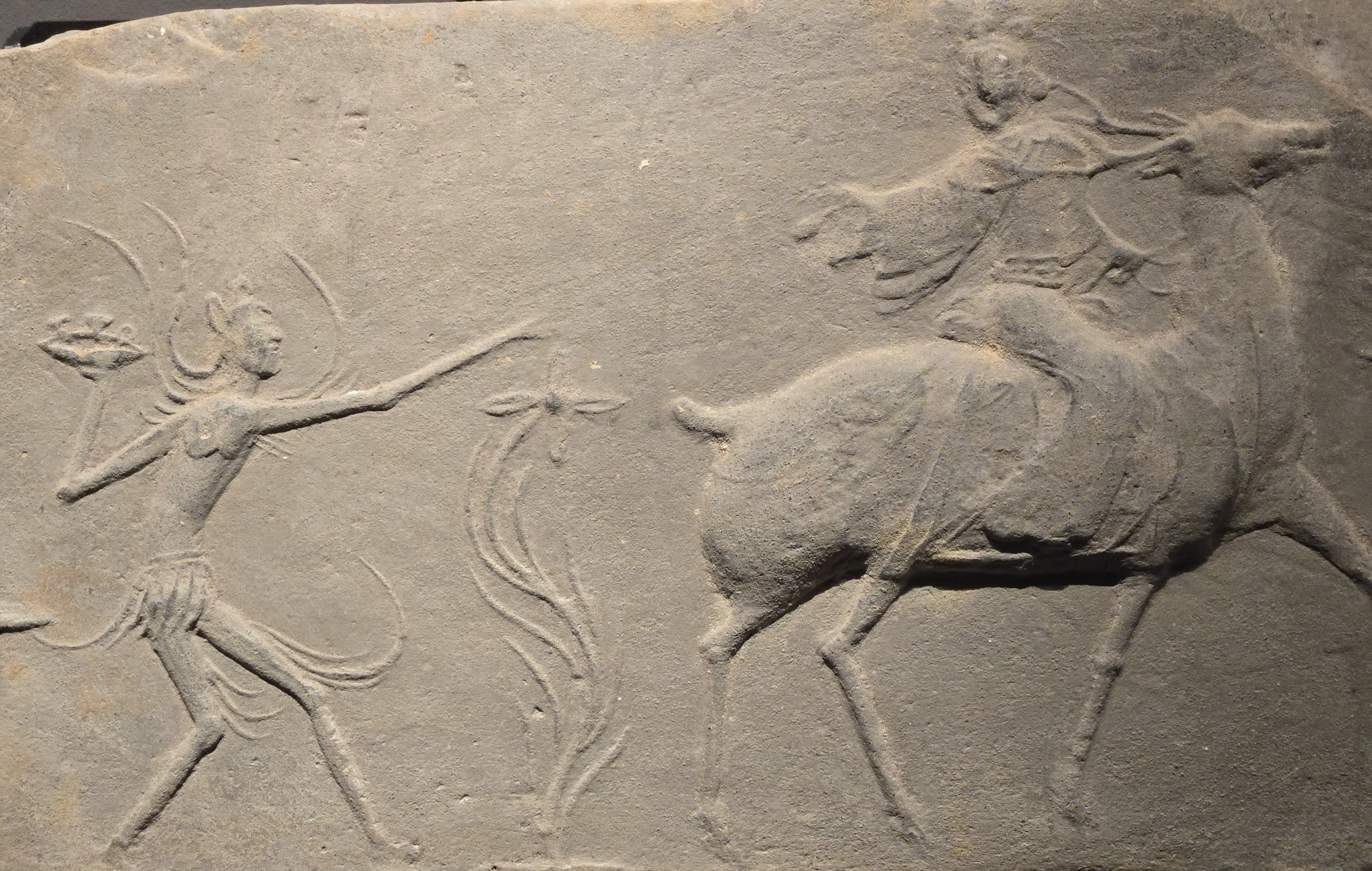
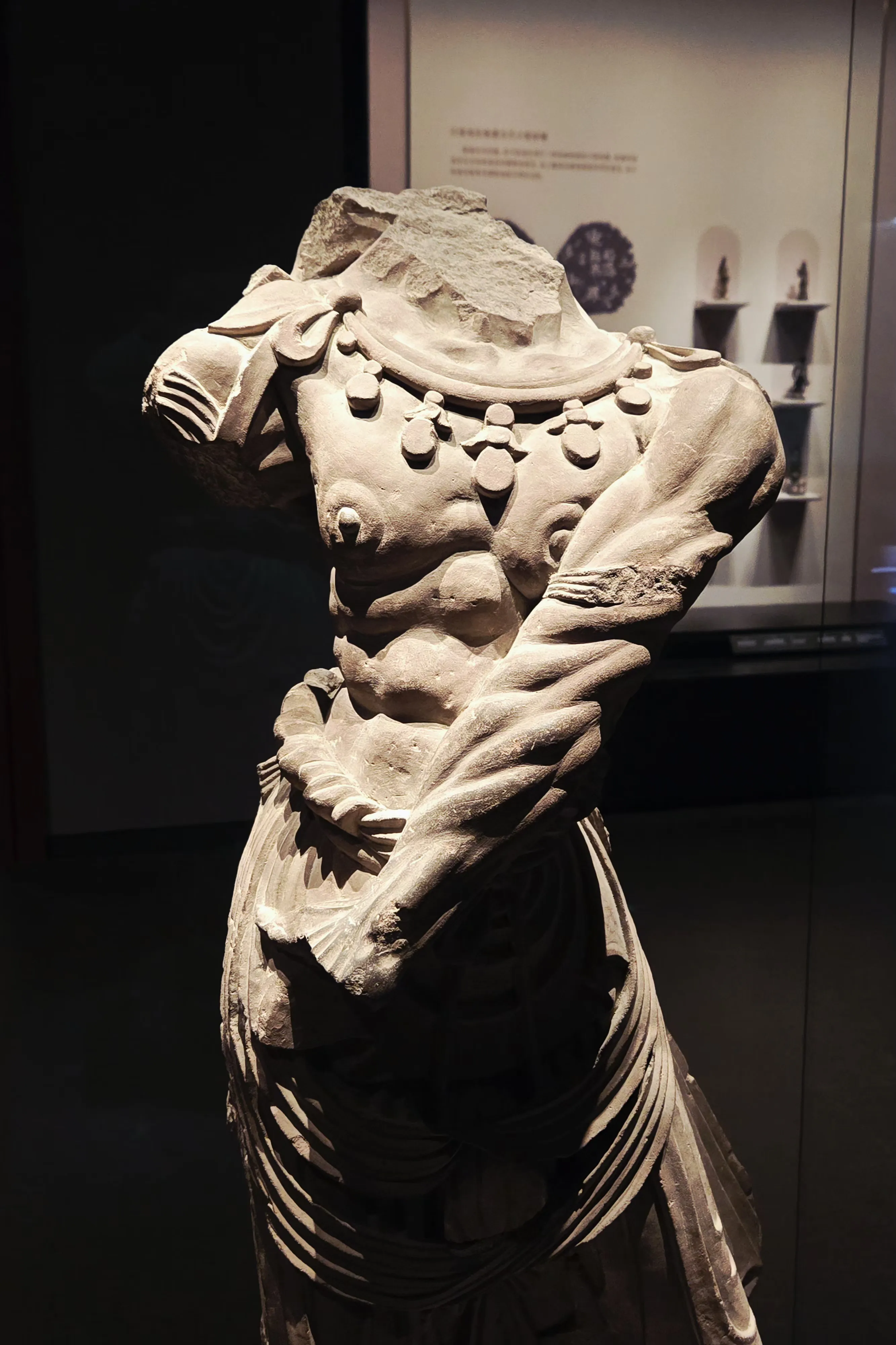
The Qin-Han gallery explained the association between horses and rank. The displayed pictorial brick “Carriage and Horses Crossing a Bridge” easily calls to mind the story of Sima Xiangru.
Ten li north of the city is Shengxian Bridge, with Songke View nearby. When Sima Xiangru first entered Chang’an, he inscribed on the city gate: If I do not return riding a red carriage with four horses, I will not pass beneath you.
Chang Qu, Huayang Guozhi · Shu Records
In the ritual imagination of the pre-Qin and Han periods, the number of horses symbolized social rank: “The Son of Heaven drives six horses; feudal lords drive four; great officers three; scholars two; commoners one.”[1]The reference material quotes Book of the Later Han · Treatise on Carriages and Clothing as saying, “The Son of Heaven drives six horses; feudal lords drive four; great officers three; scholars two; commoners one.” Similar statements are also commonly cited as text from the lost Yili · Wangdu Ji, with variants such as “feudal lords drive four” and “feudal lords drive five, ministers drive four.” The original meaning of si is four horses harnessed together. “Red carriage and four horses” can be understood as a combined image of visible rank: a red vehicle and a four-horse high carriage. I will not expand on the textual variants in ritual systems here, only taking its most intuitive layer in the Sima Xiangru story: four horses abreast represent a status beyond ordinary daily travel. Leaving Shu for the passes and seeking office in Chang’an, what Sima Xiangru wrote down was a wish to return home in glory: a red high carriage, four horses abreast, crossing the bridge back through Chengdu’s north gate.
The Shengxian Bridge in that line was ten li north of Chengdu Commandery, beside Songke View, right on the route north out of Chengdu and along the Shu roads toward Chang’an. After the Tang, “Shengxian Bridge” was gradually overshadowed by the name “Sima Bridge”; the place name itself was rewritten by Sima Xiangru’s vow. After the railway was built in the 1950s, the old bridge no longer stood on its original site. Today’s Sima Bridge is roughly two hundred meters downstream from it.[2]See the local gazetteer article from Jinniu, 一座励志桥 见证最强誓言: Sima Bridge was originally named Shengxian Bridge and crossed the Sha River, anciently called Shengxian Water. In 1951, when the Chengdu-Chongqing Railway was built, the old bridge was demolished. Later, after the Sha River was rerouted, it was rebuilt about 200 meters downstream from the original site.
The pictorial brick was excavated from the Dongxiang Qinggangbao Han tomb near Chengdu’s north gate, very close to the old site of Sima Bridge. On the brick, a high carriage crosses a bridge with mounted attendants following, showing that in the lived experience of Han people, carriages, horses, attendants, and status were indeed bound together.[3]The same article notes that the “Carriage and Horses Crossing a Bridge” pictorial brick was excavated from the Dongxiang Qinggangbao Han tomb. The tomb site lies west of Sima Bridge at Chengdu’s north gate and east of the North Railway Station, very close to Sima Bridge. The brick shows a flat wooden bridge, two horses pulling a high carriage across it, and riders following alongside.
The same still holds in modern times. When later archaeologists look back at the 21st-century internet, perhaps they will discover precious materials like this:
You drive xx back home in glory. Your old uncle seats you at the center of the banquet. A cousin-in-law you have never met knows you do not eat scallion or ginger.
The chicken was just slaughtered, the fish is wild, and none of the red envelopes you take out are thin.
The elders raise their cups while watching your microexpressions, hoping you can sort out your younger cousin’s job, since they have thought you were capable since childhood.
Sima Xiangru did eventually realize his ambition. Later scholars also used his bridge inscription to encourage themselves:
He went to inscribe the pillar of the long bridge,
still in his time before success.
When at last he rode a four-horse carriage,
he returned across the bridge.
His name flows with the eastward water,
endless and unceasing.Cen Shen, “Shengxian Bridge”
His lofty resolve began with inscribing the pillar;
my own life alone turns like windblown tumbleweed.
Years of spring grass have withered,
and today I am poor at the end of the road.Du Fu, “Presented to Geshu, Commander of the Bureau”
One should learn from Xiangru’s resolve;
in the end, one must return with four horses.Xu Hun, “On Leaving for the Capital, Inscribed at Sun the Recluse’s Mountain Dwelling, Two Poems”
Having sold rhapsodies and gained fame after selling wine,
he returned with four horses surrounding his high carriage.Xu Jun, “Sima Xiangru”
On the official carriage I plan to submit a Changyang rhapsody;
at the farewell road, I first inscribe Sima Bridge.Wen Zhengming, “Sending Qian Yuanyi to the Metropolitan Examination”
The villagers gather on Taiping Bridge,
hoping you return in a high carriage with four horses.Han Yong, “Sending Zuo Zan, Tribute Scholar of Nancheng, to the Spring Examination Again”
During the visit, I also saw an exhibition panel about Mount Qingcheng: its Daoist reputation is related to Zhang Daoling entering the mountain to practice the Dao. Beside it was also a panel about Qingyang Palace, so the next day’s itinerary connected itself naturally.
Jiangdu Temple
Of all the great waters under heaven, there are four known as the Four Düs: the Yangtze, the Yellow River, the Huai, and the Ji. “Dü” means “independent” — each springs from its own source and flows unaccompanied into the sea.
Shiming · On Waters
In ancient China, the four rivers that emptied directly into the sea were revered as the Four Düs, with the Yangtze ranking first. Its official divine title was “the God of the Southern Dü Great River”. Rooted in the ancient belief that “the Yangtze originates from the Min Mountains” (which regarded the Min River as the Yangtze’s true source), the Qin dynasty established the primary official temple for the Yangtze god in the Shu region after unifying all under heaven.
After exploring the exhibition halls, exit Sichuan Museum through the north gate. In the courtyard to the east stands a reconstructed pavilion honoring the original Jiangdu Temple, where three bronze deity statues cast in the Chenghua period of the Ming Dynasty are on permanent display. Seated majestically at the center is the Yangtze’s supreme god, flanked by two attendant goddesses. With deeply etched drapery lines and a solemn, stately bearing, they still carry the gravitas of ancient state rituals more than five centuries later.
After the visit, I picked up my stored luggage and strolled slowly along the Huanhua Stream outside the museum. The quiet, clear waters made for a wonderfully atmospheric end to the day.
Huanhua Creek
This stretch of Huanhua Creek makes people slow down. The greenery is good. Large patches of blue plumbago were blooming by the water, with sparrows, spotted doves, and the occasional night heron. In the distance someone was playing a hulusi.
I was preparing to head toward the garden area of Du Fu Thatched Cottage, walking along the creek bank. After a few steps, I climbed the stone stairs back to the road and found that one source of the music was a middle-aged man.
Then I entered Huanhua Creek Park. It connects to Du Fu Thatched Cottage to the north and Sichuan Museum to the east.
Today, Huanhua Creek Park is an open urban forest park. Its official site divides it into three themed areas: Wanshu Mountain, Canglang Lake, and Egret Island.[4]Chengdu Du Fu Thatched Cottage Museum’s official page 浣花园林区 says Huanhua Creek Park is the core area of the Huanhua Creek Historical and Cultural Scenic Area, divided into the three themed areas of Wanshu Mountain, Canglang Lake, and Egret Island.
Du Fu Thatched Cottage
I wandered in Huanhua Creek Park for quite a while and did not reach the east gate area of Du Fu Thatched Cottage until 4:30. On Amap, I saw the student ticket was 25 yuan. It did not feel expensive, so I bought one.
There were not many visitors that afternoon, and the sunlight was not strong, so the park was comfortable to walk through.
After enduring hardship in Chang’an, the death of his young son from hunger, and the An Lushan Rebellion, Du Fu finally arrived in Chengdu in the winter of 759. The following spring, he built a thatched cottage by Huanhua Creek. He lived here for three years and nine months in total, and more than 240 poems from his Chengdu period have survived.[5]Chengdu Du Fu Thatched Cottage is the former residence where the poet-sage Du Fu lived in exile in Chengdu. In the winter of 759, to avoid the An Lushan Rebellion, Du Fu brought his family to Chengdu. The following spring, he built a “thatched cottage” beside Huanhua Creek and lived there. Du Fu stayed here for three years and nine months in total, and more than 240 poems he wrote here have survived. Chengdu Du Fu Thatched Cottage is known as a “sacred site in the history of Chinese literature.” At the end of the Tang, the poet Wei Zhuang found the site of the cottage and rebuilt a thatched house. Since then, Du Fu Thatched Cottage has undergone fourteen major repairs and expansions through the Song, Yuan, Ming, Qing, and modern periods. After the founding of the PRC, it was fully renovated in 1952 and officially opened to the public. In 1955, Du Fu Memorial Hall was established; in 1985, it was renamed Chengdu Du Fu Thatched Cottage Museum. It is now among the first batch of Major Historical and Cultural Sites Protected at the National Level, a national first-class museum, a national key protection unit for ancient books, and a national 4A tourist attraction. Its area has grown from the “first acre of cut thatch” when Du Fu built the cottage to nearly 800 mu today, including 300 mu of cultural relic area and 500 mu of Huanhua garden area.
Chengdu Du Fu Thatched Cottage Museum - Overview - Cottage Introduction
When the cottage was completed, he wrote “The Cottage Completed,” depicting white thatch behind the city wall, a familiar riverside path, alder (桤) groves[6]Alder (Alnus cremastogyne) is a plant in the birch family, genus Alnus, endemic to China. In classical writing it was written as 机 (not the simplified form of 機); Yang Xiong’s Shu Capital Rhapsody has the line “spring alders and willows.” It is a deciduous tree with oblong leaves and sparse serrations along the edges. It flowers in spring, is monoecious, has solitary catkin inflorescences in the axils of new shoots, and has drooping fruiting spikes, structurally somewhat like alder.[7]How should one understand Chengdu’s poetry?
“I have visited many ancient towns in Jiangsu and Zhejiang, and you will notice one phenomenon: of course the towns are beautiful, but their courtyards are often in large clusters, one next to another. You can tell at a glance that they were once ‘rich neighborhoods.’ But Chengdu is different. Beside the residence of an official or noble in Chengdu, there might be a shoe shiner, a rickshaw puller, or a beggar. But being separated by one wall does not stop you from basking in the same sunlight or me from bathing in the same moonlight. If your family has money, you can plant nanmu trees; if I am poor, I plant alders. But I can still drink a bowl of tea under the trees and enjoy a little coolness.”
This is the poetic Chengdu in Jiang Lan’s eyes. Perhaps a passage from “Chengdu’s Alder Trees” in his book Notes from Shu explains it more directly:
In my view, Chengdu’s ease does not lie in deep courtyards or winding paths and lotus in the wind. It lies in sitting idly with tea, listening alone to qin music under the rain eaves, and watching petty squabbles with a cold eye. Tall nanmu and solemn ginkgo often protect high temples and grand mansions. But the ordinary alder, unfit to become beams and pillars, happens in its rise and fall to contain the common heart of the people of Shu: bamboo fences and thatched cottages have fine scenery; Daoist temples and Buddhist halls cannot compare.
从成都过客到“城市主笔”,他看到这座城市独有的诗意_蒋蓝, bamboo shadows, and dew.
Behind the city, the cottage completed, shaded by white thatch;
along the river, a familiar path bends over green fields.
Alder groves block the sun, leaves singing in the wind;
caged bamboo mingles with mist, dripping dew from its tips.Du Fu, “The Cottage Completed”
Du Fu had a brief peace, but unfortunately the thatched roof was later swept away by autumn winds. From that came the famous line in “Song of My Cottage Unroofed by Autumn Gales”: “How can I obtain ten thousand great houses, to shelter all poor scholars under heaven and make them all rejoice?”
Li-Du Hall
At the Renri event in 2024, Li-Du Hall at Du Fu Thatched Cottage Museum officially opened. The exhibition introduces the friendship between Li Bai and Du Fu, and also later generations’ imagination and admiration for their meeting.
Their three meetings were later summarized as “first meeting in Luoyang, gathering again in Liang and Song, and meeting once more in Qilu.” When I saw the place name “Lixia Pavilion,” as someone from Shandong, I also felt a bit honored by association.
Another place name I remembered was Jiangyou, where Li Bai grew up.
Seeing the two characters “Jiangyou” immediately made me think of a social news story from last year: local residents protested against what they saw as unfair police handling of a bullying incident, and the situation eventually broke into conflict. Helpful netizens added the BGM “Guangzhou Unlimited Fighting Tournament.” This world is truly deranged
BTW, when Suzhou’s Changshu comes up, I also easily think of Arnold; when Chengdu’s Xinjin is mentioned, my reflex is Sun Xiaochuan.
Li-Du Hall also has AR figures of Li Bai and Du Fu. A couple around thirty were talking with Li Bai. The woman asked, “You are so handsome. What kind of girl do you like?” The AR replied that he indeed had sword-like brows and bright eyes and an elegant bearing, followed by a bunch of words I forgot, and said he liked girls who washed clothes under the moon, followed by more words I forgot.
AI makes the impossible possible. Even great poets have to keep working after death, though it is genuinely interesting.
Flower Path
After leaving Li-Du Hall, I wandered at random. Eventually I planned to head toward Wanfosi Tower, which meant passing through the Flower Path. It is a narrow path between red walls, connecting the memorial building complex of Du Fu Thatched Cottage with the original Caotang Temple. The red walls, grey tiles, green bamboo, and moss on the tiles in the photo all belong to this section.
At the end of the Flower Path is the “Caotang Screen Wall.” In the late Qing, Zhou Shanpei, Sichuan’s Dao-yin for industrial promotion, used broken blue-and-white porcelain to inlay the two characters “Caotang” on the screen wall. It was damaged several times later and repaired several times. In 1958, when Mao Zedong visited the Thatched Cottage, he also stopped in front of these two characters.
On the ground at Sichuan Museum, you can also find a path paved with broken porcelain, in the outdoor park with the God of the Yangtze mentioned earlier.
Wanfosi Tower
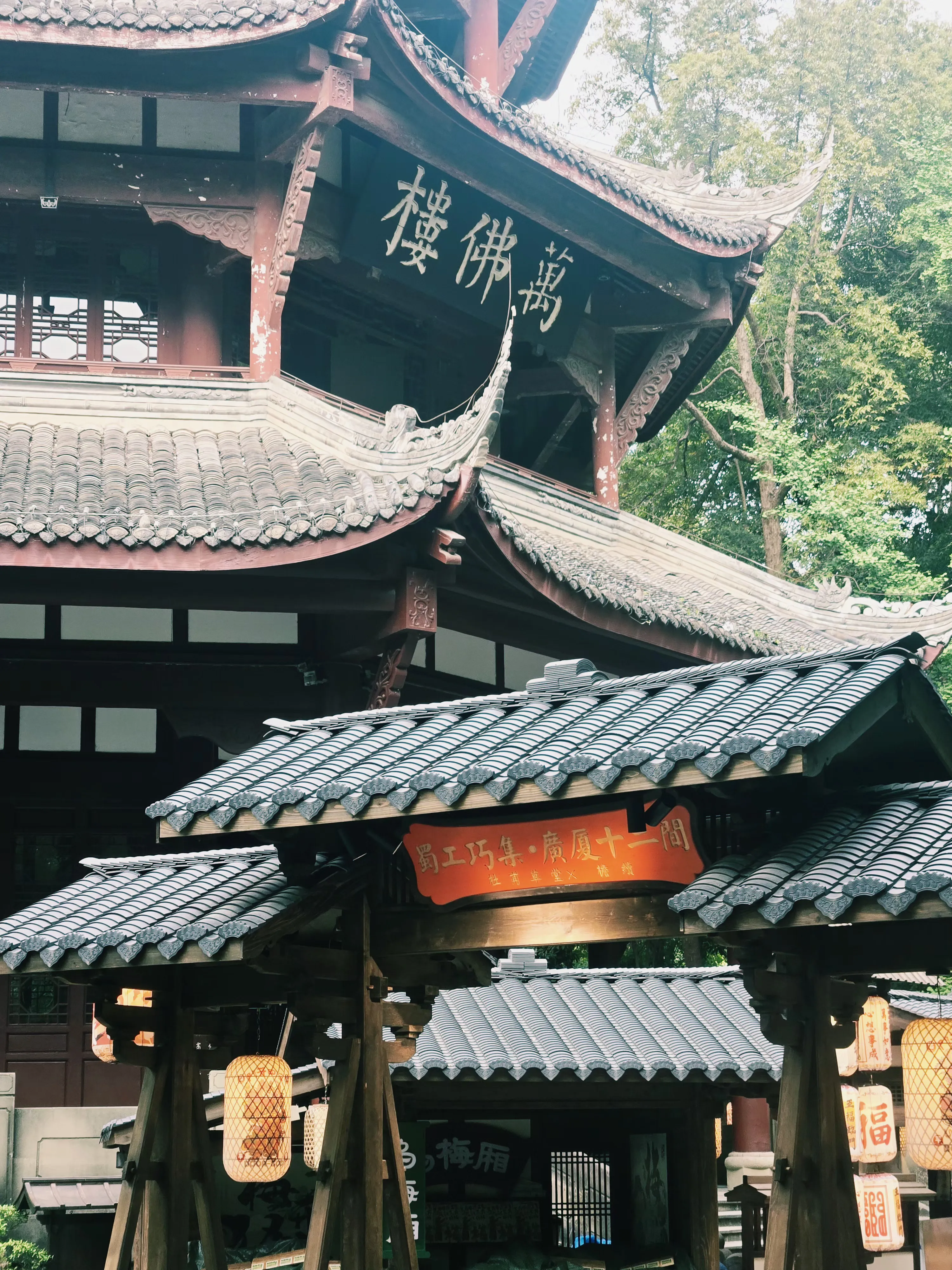
Because I arrived late, the later itinerary became a bit rushed. I reached it at 5:40 PM. The tower is a reconstruction, and visitors can climb it for a view. With several years of experience climbing seven floors on foot in Xinyuan, I reached the top easily.
On the top floor hangs a bronze bell with an inscription. Walking to the balcony and looking down, I saw a continuous canopy of trees and high-rises in the distance. Looking up, I could also see planes passing overhead. I saw two in about ten minutes; they were probably heading toward Shuangliu Airport.
There were not many people on the roof. A middle-aged uncle sat there for a long time before going downstairs. Another man around thirty was also taking photos and later asked me to help take a few. This was probably the second time I had helped a stranger take photos. The last time was at Jinji Lake in Suzhou.
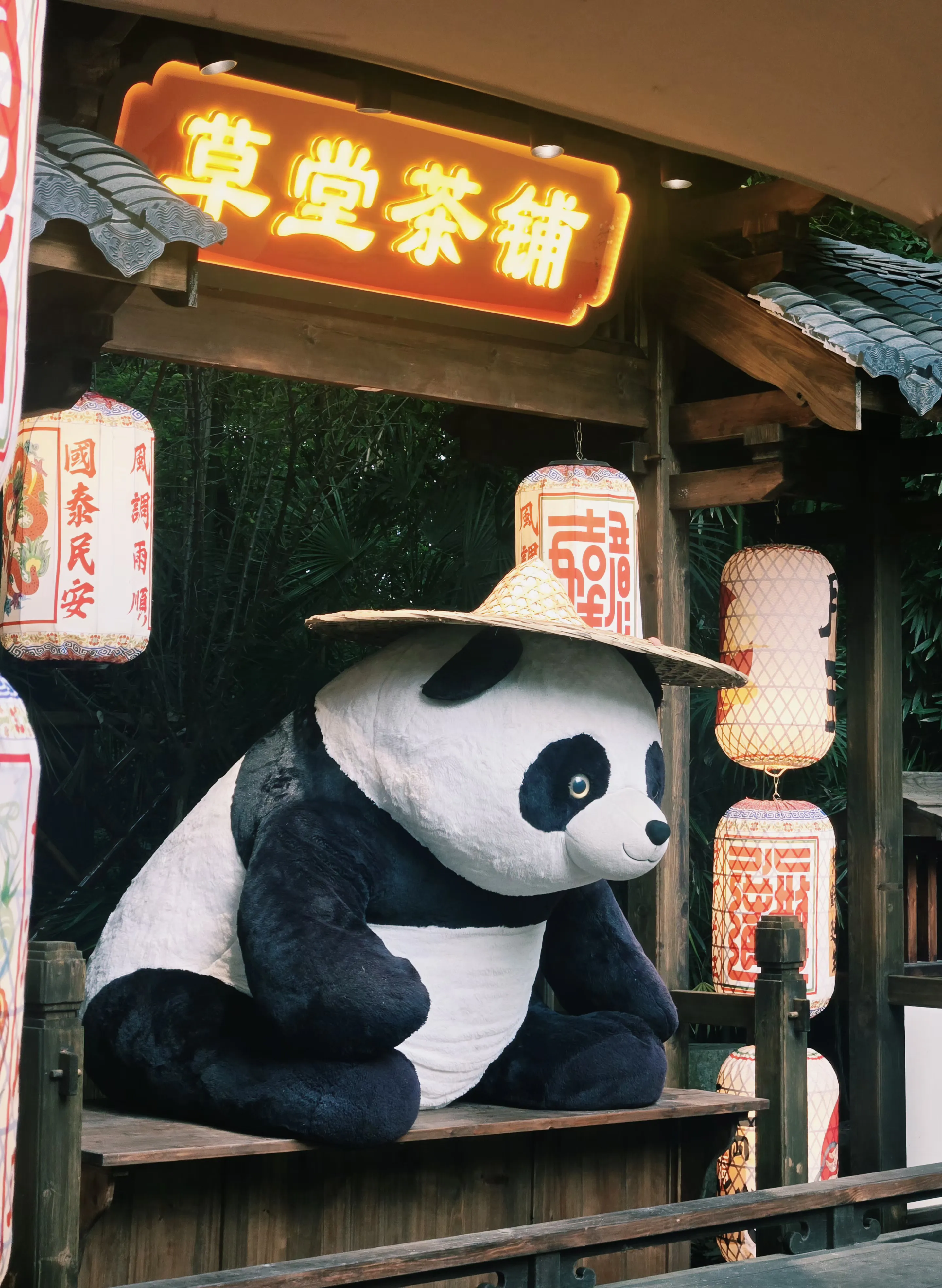
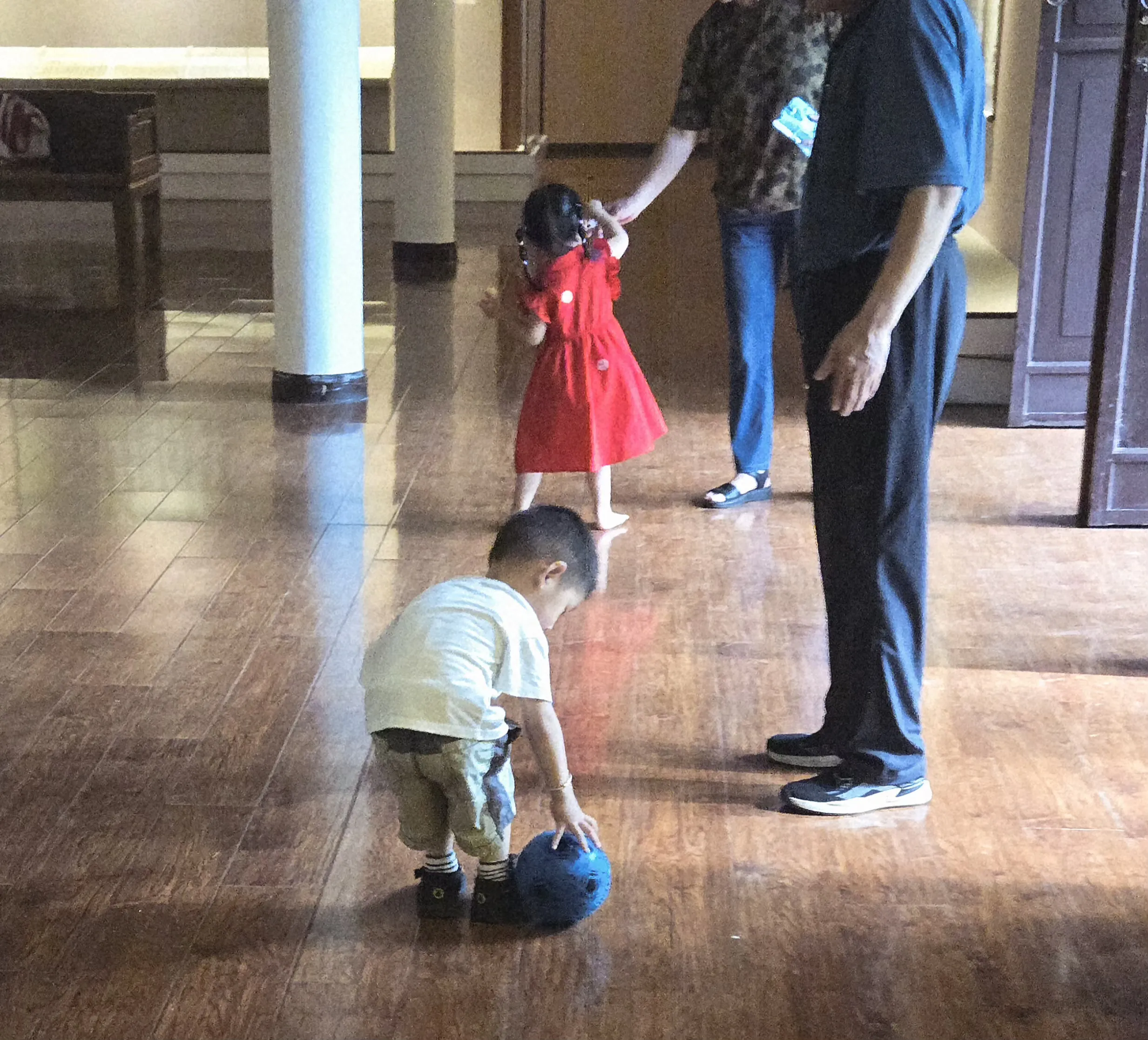
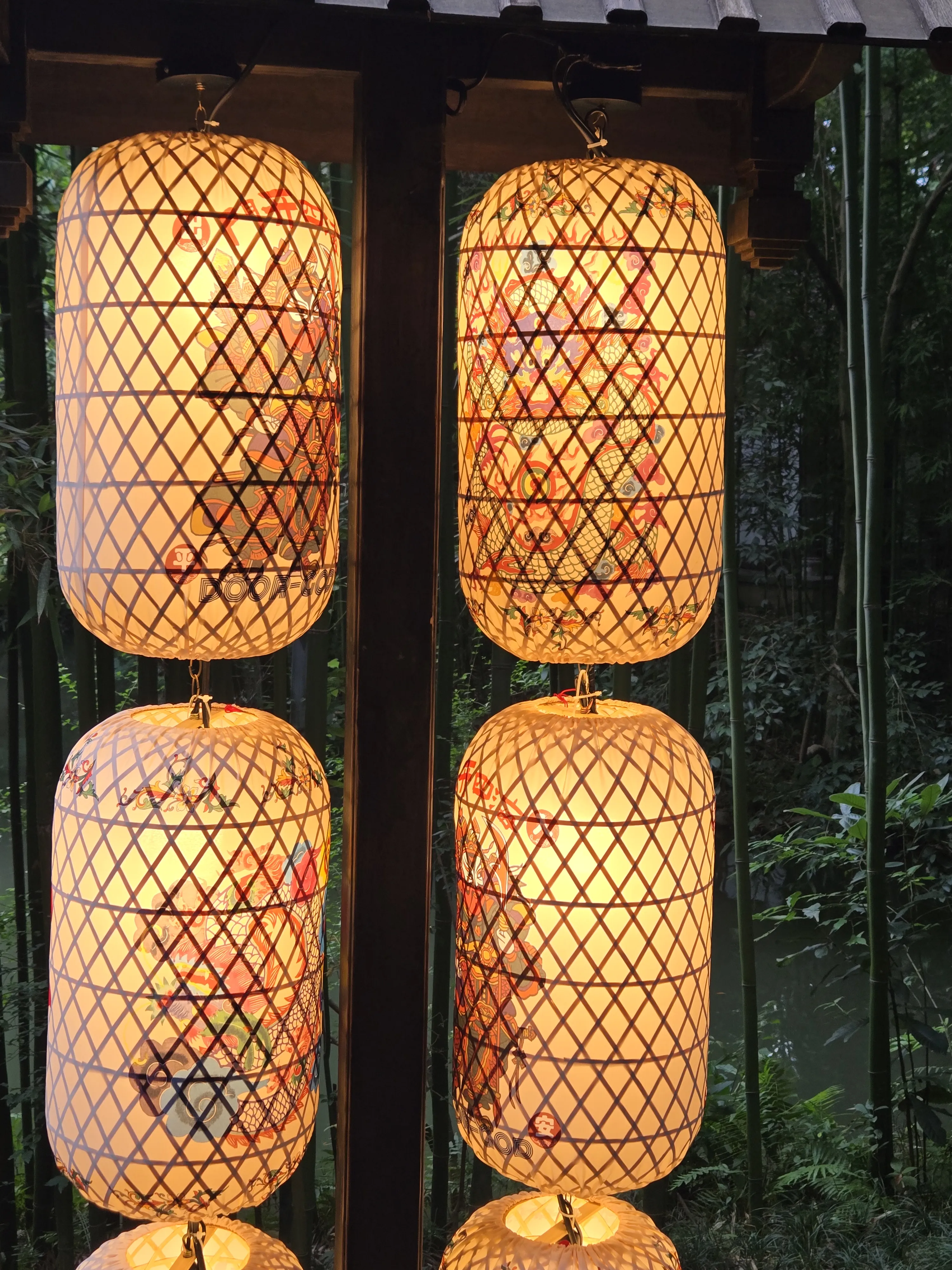
Standing on a high tower changes the view immediately. Below was an endless tree canopy; in the distance were Chengdu’s high-rises; two planes crossed the sky, probably taking off from Shuangliu Airport.
Epilogue
When it was time, I prepared to leave. I originally wanted to go out through the main gate and see the cottage ruins along the way, but when I reached the main gate it was already after six, and the gate was closed.
Just then a group of visitors came from the south gate and said that the south gate was closed too. There was no choice but to walk to the north gate. The main north gate was also closed, but the security guard had left a side passage open for people to exit.
After leaving the Thatched Cottage, I sat at the entrance for a while, unsure what to eat. In the end, I got on the metro first. On Xiaoxiang Supermarket, I bought tiramisu, matcha pudding, and one kilogram of red date yogurt.
After returning, I stayed in the library until around 8:15. Unfortunately I had not brought my charger; otherwise I could have stayed until closing.
During that time I watched a few Bilibili videos, including an explanation of Du Fu Thatched Cottage and one about why electric scooters in Guangzhou and Shenzhen are so chaotic. I also came across an introduction to Yan Wu on Zhihu, the man who helped Du Fu settle in Shu. I read it with great interest, then checked it against Old Book of Tang and found errors everywhere. The reviews of Old Book of Tang on WeChat Reading were also uneven. Names, temple names, and years were all made up at random. Speechless!
The reference material quotes Book of the Later Han · Treatise on Carriages and Clothing as saying, “The Son of Heaven drives six horses; feudal lords drive four; great officers three; scholars two; commoners one.” Similar statements are also commonly cited as text from the lost Yili · Wangdu Ji, with variants such as “feudal lords drive four” and “feudal lords drive five, ministers drive four.” The original meaning of
siis four horses harnessed together. “Red carriage and four horses” can be understood as a combined image of visible rank: a red vehicle and a four-horse high carriage. I will not expand on the textual variants in ritual systems here, only taking its most intuitive layer in the Sima Xiangru story: four horses abreast represent a status beyond ordinary daily travel. ↩︎See the local gazetteer article from Jinniu, 一座励志桥 见证最强誓言: Sima Bridge was originally named Shengxian Bridge and crossed the Sha River, anciently called Shengxian Water. In 1951, when the Chengdu-Chongqing Railway was built, the old bridge was demolished. Later, after the Sha River was rerouted, it was rebuilt about 200 meters downstream from the original site. ↩︎
The same article notes that the “Carriage and Horses Crossing a Bridge” pictorial brick was excavated from the Dongxiang Qinggangbao Han tomb. The tomb site lies west of Sima Bridge at Chengdu’s north gate and east of the North Railway Station, very close to Sima Bridge. The brick shows a flat wooden bridge, two horses pulling a high carriage across it, and riders following alongside. ↩︎
Chengdu Du Fu Thatched Cottage Museum’s official page 浣花园林区 says Huanhua Creek Park is the core area of the Huanhua Creek Historical and Cultural Scenic Area, divided into the three themed areas of Wanshu Mountain, Canglang Lake, and Egret Island. ↩︎
Chengdu Du Fu Thatched Cottage is the former residence where the poet-sage Du Fu lived in exile in Chengdu. In the winter of 759, to avoid the An Lushan Rebellion, Du Fu brought his family to Chengdu. The following spring, he built a “thatched cottage” beside Huanhua Creek and lived there. Du Fu stayed here for three years and nine months in total, and more than 240 poems he wrote here have survived. Chengdu Du Fu Thatched Cottage is known as a “sacred site in the history of Chinese literature.” At the end of the Tang, the poet Wei Zhuang found the site of the cottage and rebuilt a thatched house. Since then, Du Fu Thatched Cottage has undergone fourteen major repairs and expansions through the Song, Yuan, Ming, Qing, and modern periods. After the founding of the PRC, it was fully renovated in 1952 and officially opened to the public. In 1955, Du Fu Memorial Hall was established; in 1985, it was renamed Chengdu Du Fu Thatched Cottage Museum. It is now among the first batch of Major Historical and Cultural Sites Protected at the National Level, a national first-class museum, a national key protection unit for ancient books, and a national 4A tourist attraction. Its area has grown from the “first acre of cut thatch” when Du Fu built the cottage to nearly 800 mu today, including 300 mu of cultural relic area and 500 mu of Huanhua garden area.
Chengdu Du Fu Thatched Cottage Museum - Overview - Cottage Introduction ↩︎
Alder (Alnus cremastogyne) is a plant in the birch family, genus Alnus, endemic to China. In classical writing it was written as
机(not the simplified form of機); Yang Xiong’s Shu Capital Rhapsody has the line “spring alders and willows.” It is a deciduous tree with oblong leaves and sparse serrations along the edges. It flowers in spring, is monoecious, has solitary catkin inflorescences in the axils of new shoots, and has drooping fruiting spikes, structurally somewhat like alder. ↩︎How should one understand Chengdu’s poetry?
“I have visited many ancient towns in Jiangsu and Zhejiang, and you will notice one phenomenon: of course the towns are beautiful, but their courtyards are often in large clusters, one next to another. You can tell at a glance that they were once ‘rich neighborhoods.’ But Chengdu is different. Beside the residence of an official or noble in Chengdu, there might be a shoe shiner, a rickshaw puller, or a beggar. But being separated by one wall does not stop you from basking in the same sunlight or me from bathing in the same moonlight. If your family has money, you can plant nanmu trees; if I am poor, I plant alders. But I can still drink a bowl of tea under the trees and enjoy a little coolness.”
This is the poetic Chengdu in Jiang Lan’s eyes. Perhaps a passage from “Chengdu’s Alder Trees” in his book Notes from Shu explains it more directly:
In my view, Chengdu’s ease does not lie in deep courtyards or winding paths and lotus in the wind. It lies in sitting idly with tea, listening alone to qin music under the rain eaves, and watching petty squabbles with a cold eye. Tall nanmu and solemn ginkgo often protect high temples and grand mansions. But the ordinary alder, unfit to become beams and pillars, happens in its rise and fall to contain the common heart of the people of Shu: bamboo fences and thatched cottages have fine scenery; Daoist temples and Buddhist halls cannot compare.