On National Day, I visited the Shanghai Natural History Museum, where the special exhibition “Deep Time: From Fish to Human” was running in the B1 temporary exhibition hall. Admission required a separate ticket, priced at ¥88.
The light and projection displays in the final section, “Oceans of the Future,” were impressive. I gave the earlier text panels less attention: I did not know the route and ended up reading them out of order. They felt like recordings and letters scattered through a game, leaving me to piece together the context.
I only came to understand what made many of the exhibits significant after the visit, when I read more about them. To get more out of those 88 yuan, it helps to learn a little of the background and check the exhibition route beforehand.
Why can we find counterparts to the bones of our upper arms and forearms in the fins of ancient fish? From notochords and jaws to limbs, familiar parts of our bodies have histories far longer than that of humanity.
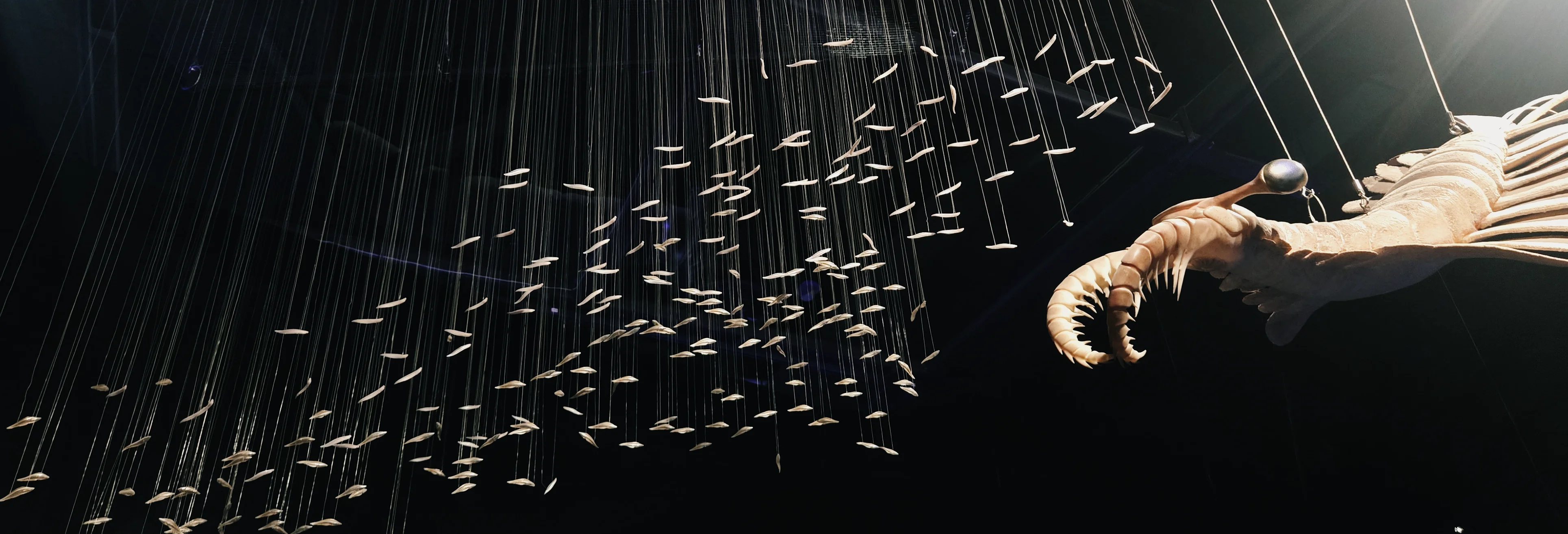
From Notochord to Limbs
The developments below span nearly 200 million years, from the Cambrian to the Devonian. This table gives a rough sense of the timeline; you can return to it as you read about individual fossils.Geological period Approximate age Evolutionary developments Cambrian 540–490 million years ago Fossils such as Haikouichthys from the Chengjiang biota preserve features of early vertebrate anatomy. Ordovician 490–440 million years ago Jawless fishes continued to evolve; molecular clock estimates place the origin of jawed vertebrates as far back as this period. Silurian 440–420 million years ago Fossils from Chongqing and Guizhou document early jawed fishes, offering clues to the origins of teeth, skulls, and paired appendages. Devonian 420–360 million years ago Often called the “Age of Fishes”; some branches of the lobe-finned fishes gradually developed features approaching those of tetrapods.
Notochord and Vertebral Column
Haikouichthys lived in Cambrian seas more than 500 million years ago. Only a few centimetres long, it is among the oldest known vertebrates. Its fossils from the Chengjiang biota in Yunnan preserve structures including the head, muscles, and central body axis.
These early vertebrates did not yet have a segmented, bony spine like ours. Two images help distinguish the structures: a notochord is like a flexible support rod; a vertebral column is like a chain of connected bones. The difference is not simply one of hardness. They also differ in structure and developmental origin.
The notochord runs along the length of the body: a continuous rod made of cells enclosed in a connective tissue sheath. It can bend while resisting compression along its length. As muscles on either side contract in turn, the notochord provides support, allowing the body to bend from side to side instead of simply bunching up.[1]OpenStax, Biology 2e, 29.1 Chordates; Giovanni Annona, Nicholas D. Holland, and Salvatore D’Aniello, Evolution of the notochord, EvoDevo, 2015. These sources describe the notochord’s structure, supporting role, and retention in different groups. Some vertebrates retain a well-developed notochord in adulthood.
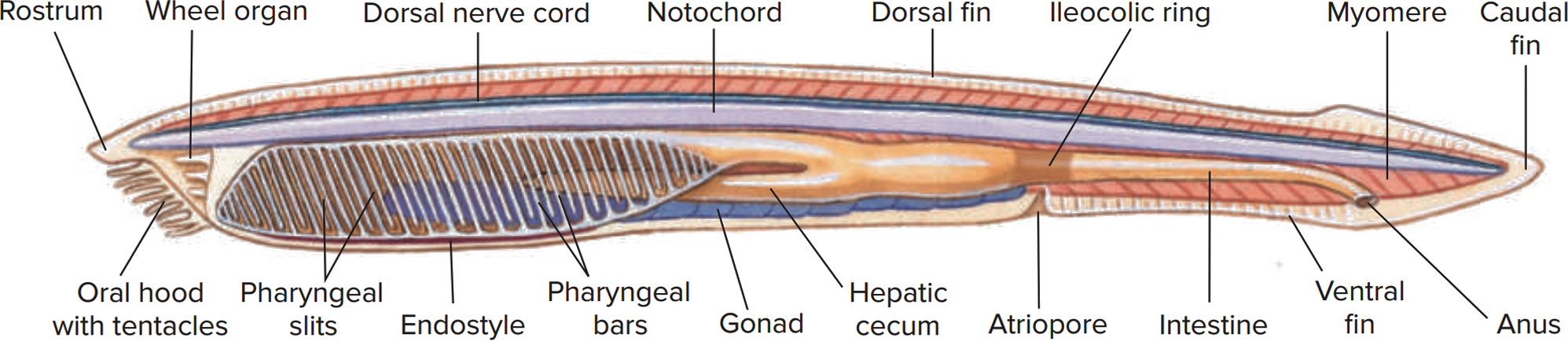
The living lancelet in this diagram helps show where these structures sit. The pale purple rod is the notochord, and the thin dark blue tube above it is the dorsal nerve cord, part of the nervous system. Both lie on the dorsal side of the digestive tract.[1:1]OpenStax, Biology 2e, 29.1 Chordates; Giovanni Annona, Nicholas D. Holland, and Salvatore D’Aniello, Evolution of the notochord, EvoDevo, 2015. These sources describe the notochord’s structure, supporting role, and retention in different groups. Some vertebrates retain a well-developed notochord in adulthood.[2]Lancelet image: Systematicist, Lancelet Anatomy, converted to WebP under CC BY-SA 4.0. Intervertebral disc image: Jmarchn, 716 Intervertebral Disk, retaining the English labels with adjusted text and leader-line colours, under CC BY-SA 3.0.
The vertebral column, by contrast, consists of a series of bones called vertebrae. In a typical human vertebra, the thick portion at the front is the vertebral body. Intervertebral discs between adjacent vertebral bodies act as cushions, allowing the spine to bear weight while remaining flexible.[3]OpenStax, Anatomy and Physiology 2e, 7.3 The Vertebral Column, on vertebrae, intervertebral discs, and the vertebral canal. For the developmental relationship between the notochord and nucleus pulposus, see also Biology 2e, section 29.1.
Behind each vertebral body, the vertebral arch and body together enclose an opening. These openings line up along the spine to form the vertebral canal, protecting the spinal cord within. The spinal cord transmits nerve signals; it is a different structure from the notochord and vertebral column, which support the body. Adjacent vertebrae also leave openings to either side called intervertebral foramina, through which spinal nerves pass.[3:1]OpenStax, Anatomy and Physiology 2e, 7.3 The Vertebral Column, on vertebrae, intervertebral discs, and the vertebral canal. For the developmental relationship between the notochord and nucleus pulposus, see also Biology 2e, section 29.1.
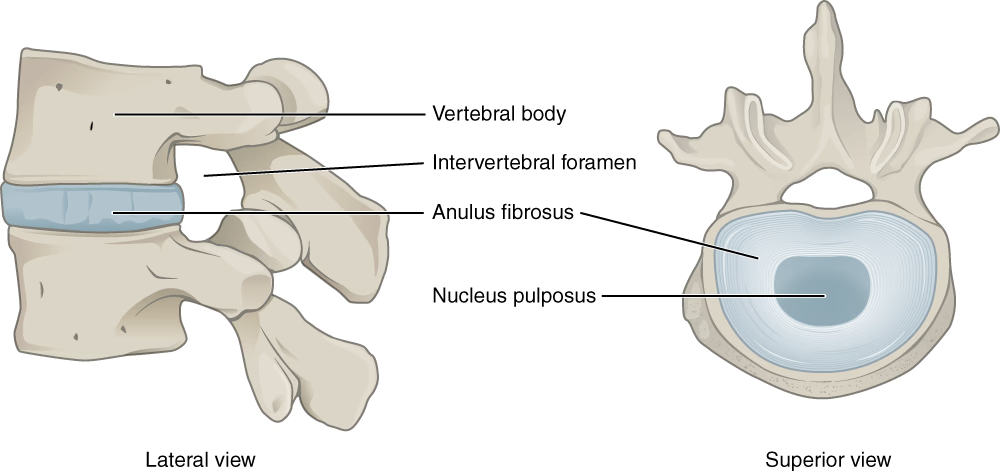
The blue intervertebral disc in the diagram has two parts: a tough outer ring, the anulus fibrosus, and a water-rich, gel-like centre, the nucleus pulposus.[3:2]OpenStax, Anatomy and Physiology 2e, 7.3 The Vertebral Column, on vertebrae, intervertebral discs, and the vertebral canal. For the developmental relationship between the notochord and nucleus pulposus, see also Biology 2e, section 29.1.
Human embryos also form a notochord early in development. As development proceeds, surrounding tissues form vertebrae, which gradually take over the main supporting role. The notochord does not simply harden into the entire vertebral column. It regresses where the vertebral bodies form, while the nucleus pulposus at the centre of each intervertebral disc has its developmental origins in the notochord.[1:2]OpenStax, Biology 2e, 29.1 Chordates; Giovanni Annona, Nicholas D. Holland, and Salvatore D’Aniello, Evolution of the notochord, EvoDevo, 2015. These sources describe the notochord’s structure, supporting role, and retention in different groups. Some vertebrates retain a well-developed notochord in adulthood.[3:3]OpenStax, Anatomy and Physiology 2e, 7.3 The Vertebral Column, on vertebrae, intervertebral discs, and the vertebral canal. For the developmental relationship between the notochord and nucleus pulposus, see also Biology 2e, section 29.1.
Jaws and Teeth
Today, the vast majority of living vertebrate species, including humans, belong to the jawed vertebrates, with upper and lower jaws. When did vertebrates first start using jaws to bite into food?
Molecular clock[4]A molecular clock estimates when lineages diverged by comparing differences in DNA or protein sequences and calibrating them against fossils and other evidence. Evolutionary rates are not constant, and the estimates carry uncertainty. estimates place their origin no later than about 450 million years ago, in the Late Ordovician. For a long time, however, the more complete fossil record reached back only to around 425 million years ago. That left a gap of tens of millions of years. Scattered fossils alone made it difficult to reconstruct the anatomy of early jawed fishes and how it changed.
Discoveries in Chongqing and Guizhou by Zhu Min’s team at the Institute of Vertebrate Paleontology and Paleoanthropology (IVPP), Chinese Academy of Sciences, have added physical evidence to help fill that gap. Two fossil deposits preserve ancient fishes from around 440 million years ago. Shiqian in Guizhou yielded microfossils such as teeth and spines, while the Chongqing fossils revealed complete bodies of early jawed fishes. The findings were published in Nature in 2022.[5]People’s Daily, republished by the IVPP: Chinese Scientists Make Major Breakthroughs in Tracing Our Origins “From Fish to Human”, September 29, 2022. Fossil dates, descriptions of the ancient fishes, the reconstruction of five fish species, and the Qianodus tooth whorl image all come from this report.
Among them is a tooth whorl from Qianodus duplicis, just over two millimetres long, found in rocks about 439 million years old. This tiny specimen extended the known fossil record of jawed vertebrate teeth by roughly 14 million years. It cannot, on its own, explain how teeth originated. But it does tell us that jawed vertebrates already had teeth by that time.[5:1]People’s Daily, republished by the IVPP: Chinese Scientists Make Major Breakthroughs in Tracing Our Origins “From Fish to Human”, September 29, 2022. Fossil dates, descriptions of the ancient fishes, the reconstruction of five fish species, and the Qianodus tooth whorl image all come from this report.
Shenacanthus vermiformis, found in Chongqing, is more completely preserved. It belongs to an early branch of cartilaginous fishes, yet its body bore bony armour plates. Early members of the lineage that includes sharks once wore armour too.[5:2]People’s Daily, republished by the IVPP: Chinese Scientists Make Major Breakthroughs in Tracing Our Origins “From Fish to Human”, September 29, 2022. Fossil dates, descriptions of the ancient fishes, the reconstruction of five fish species, and the Qianodus tooth whorl image all come from this report.
From Fins to Limbs
Tujiaaspis vividus, also discovered in Chongqing, had no jaws, but its fossils offer clues to the origin of paired appendages.[5:3]People’s Daily, republished by the IVPP: Chinese Scientists Make Major Breakthroughs in Tracing Our Origins “From Fish to Human”, September 29, 2022. Fossil dates, descriptions of the ancient fishes, the reconstruction of five fish species, and the Qianodus tooth whorl image all come from this report. Paired structures such as pectoral and pelvic fins raise another question: how are fish fins related to our limbs?
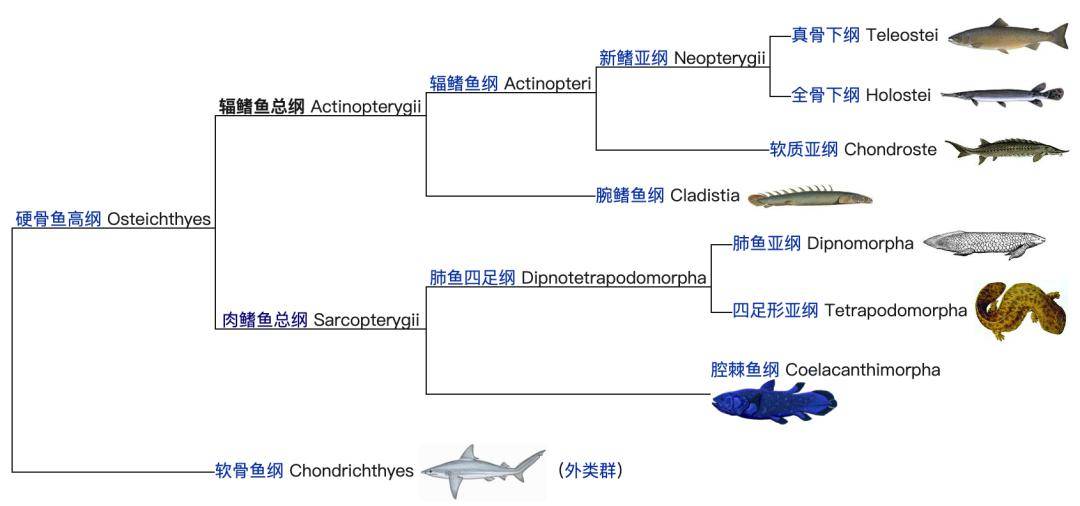
Familiar fishes such as carp and bass are ray-finned fishes. The outer portions of their fins are supported mainly by radiating fin rays. In lobe-finned fishes that retain fins, such as Latimeria, the paired fins have fleshy bases containing muscles and bones. Comparing fossils along the lineage leading to tetrapods reveals counterparts to the humerus in our upper arm and the radius and ulna in our forearm.[6]Seriously, We Are All Fish, consulted for classification, comparisons between fins and limbs, and the naming of Latimeria.
These bones in ancient fish fins and the corresponding limb bones of tetrapods are homologous structures: inherited from a common ancestor, they later changed in shape and function. Changes to the skeleton within the fins began in water; those bones later came to help support the body and enable movement on land. Moving onto land also required a range of adaptations in breathing, weight bearing, and other functions.
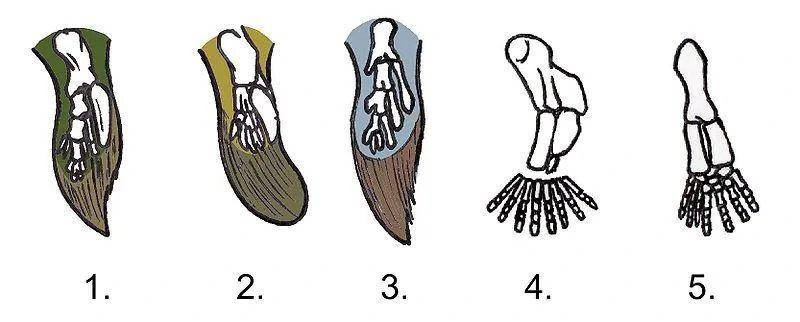
Acanthostega had eight digits on its forelimbs, while Ichthyostega had seven toes on its hindlimbs. The familiar five-digit pattern was not fixed from the moment limbs first appeared.
Are Humans Lobe-Finned Fish Too?
In everyday usage, “fish” excludes tetrapods. Cladistic classification instead groups organisms into monophyletic groups, each consisting of a common ancestor and all its descendants.
Among living jawed vertebrates, there are two main groups: cartilaginous fishes and bony fishes. Sharks and rays belong to the cartilaginous fishes; bony fishes divide into ray-finned and lobe-finned groups. Tetrapods evolved from one branch of the lobe-finned fishes. Leaving the water and growing limbs did not remove us from our ancestors’ evolutionary lineage. However distant we may seem from fish today, our bodies still bear traces of that shared ancestry.
Latimeria: The Discovery in 1938
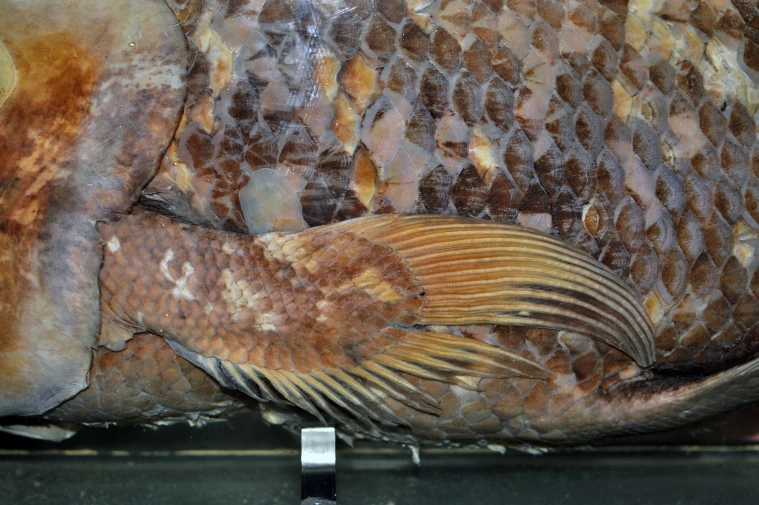
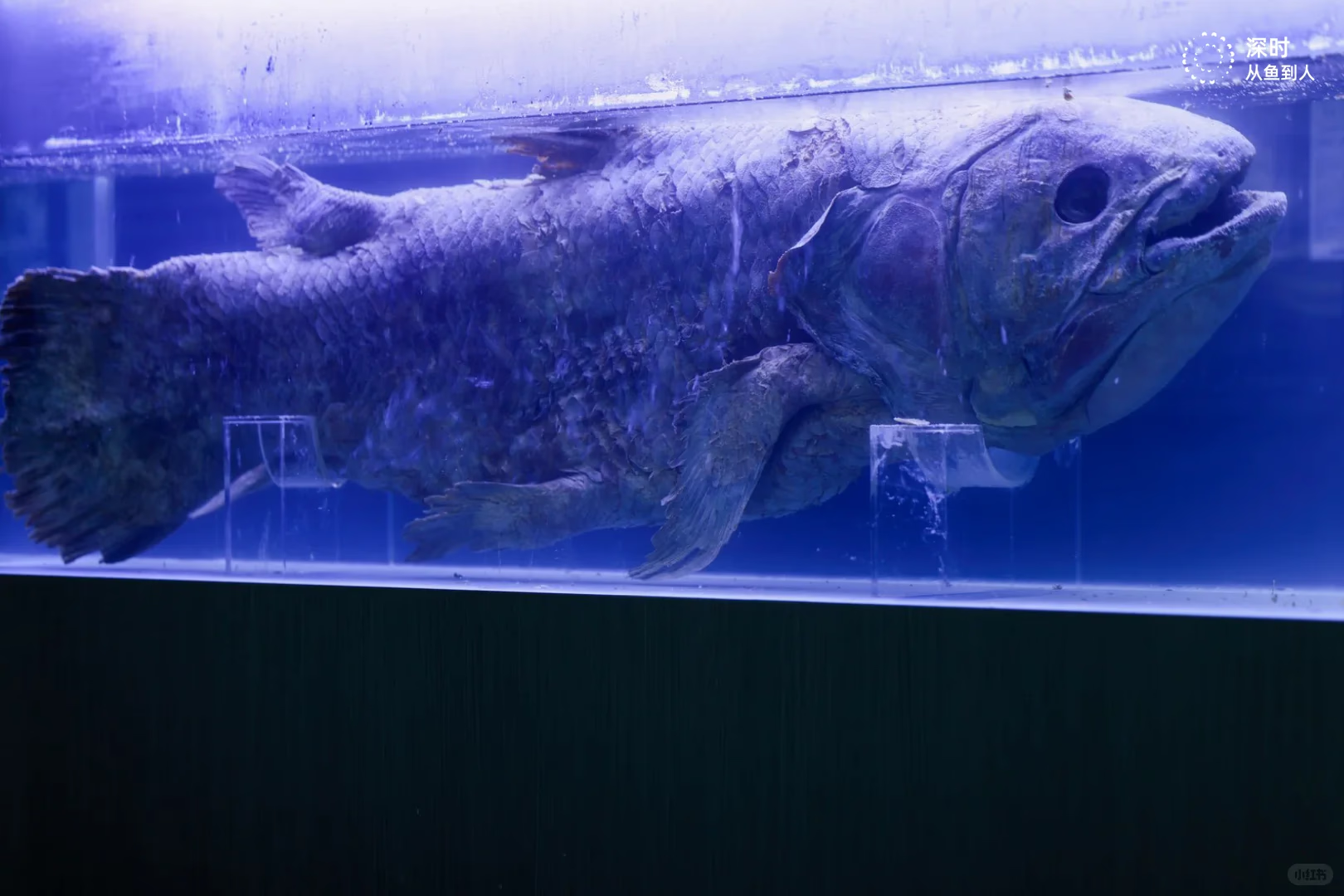
Latimeria belongs to the coelacanths, a group of lobe-finned fishes. Two living species are currently known: the West Indian Ocean coelacanth and the Indonesian coelacanth.[7]Institute of Vertebrate Paleontology and Paleoanthropology, Chinese Academy of Sciences: “Deep Time: From Fish to Human” Opens at the Shanghai Natural History Museum, September 26, 2026; exhibition preview, August 20, 2026. Before 1938, scientists knew coelacanths only from fossils and believed the group had gone extinct tens of millions of years earlier. An ordinary fishing catch changed that understanding.
The Guardian’s obituary of museum curator Marjorie Courtenay-Latimer recounts the discovery.[8]Anthony Smith, Obituary: Marjorie Courtenay-Latimer, The Guardian, May 21, 2004. The account of the discovery and quotations are based on the English original.
On December 22, 1938, Courtenay-Latimer was preparing a fossil reptile display at the East London Museum in South Africa. A phone call brought news that Captain Hendrik Goosen had returned with an interesting catch. Inspecting unusual animals caught by local fishermen was part of her routine work as curator. She set aside her preparations and took a taxi to the docks.
On Goosen’s boat, a fin first caught her eye. She later described it as “looking like a beautiful china ornament.” Picking away the slime revealed a large fish, nearly 1.5 metres long: pale mauve-blue with whitish spots and an iridescent silver-blue-green sheen. It had hard scales, limb-like fins, and a tail like a puppy’s. She called it “the most beautiful fish I had ever seen.”
Courtenay-Latimer could not identify the fish, but wanted to take it back and preserve it. The taxi driver did not want it in the boot; she insisted on bringing it along. Back at the museum, reference books offered no answer. “It’s nothing more than a rock cod,” said the chairman of the museum’s board, dismissing the find before leaving for his holiday.
The fish began to decay, and no one would provide cold storage. She eventually found a part-time taxidermist who preserved it as a specimen, though the internal organs were lost. She then sent a letter and a sketch to her friend J. L. B. Smith, who taught chemistry at Rhodes University and was also an amateur ichthyologist.
Smith later described his reaction to the sketch: “a bomb seemed to burst in my brain.” The outline looked like a coelacanth, an animal he had thought he could encounter only as a fossil. In 1939, he reported the discovery in Nature and named it Latimeria chalumnae. The genus honours Courtenay-Latimer; the species epithet comes from the Chalumna River, near where the fish was caught.[6:1]Seriously, We Are All Fish, consulted for classification, comparisons between fins and limbs, and the naming of Latimeria.
With the first fish’s internal organs missing, researchers needed another, complete specimen. Smith posted notices in several languages, but the Second World War disrupted the search. Only in 1952 did word arrive from the Comoros, north of Madagascar: another coelacanth had been found. Fourteen years had passed.
Deep Time in Our Bodies
After that extra reading, “from fish to human” meant something concrete to me: a notochord supporting a body, a set of teeth, and bones in fish fins that correspond to those in our limbs. Our connection to fish lies in these structures and our shared ancestry.
OpenStax, Biology 2e, 29.1 Chordates; Giovanni Annona, Nicholas D. Holland, and Salvatore D’Aniello, Evolution of the notochord, EvoDevo, 2015. These sources describe the notochord’s structure, supporting role, and retention in different groups. Some vertebrates retain a well-developed notochord in adulthood. ↩︎ ↩︎ ↩︎
Lancelet image: Systematicist, Lancelet Anatomy, converted to WebP under CC BY-SA 4.0. Intervertebral disc image: Jmarchn, 716 Intervertebral Disk, retaining the English labels with adjusted text and leader-line colours, under CC BY-SA 3.0. ↩︎
OpenStax, Anatomy and Physiology 2e, 7.3 The Vertebral Column, on vertebrae, intervertebral discs, and the vertebral canal. For the developmental relationship between the notochord and nucleus pulposus, see also Biology 2e, section 29.1. ↩︎ ↩︎ ↩︎ ↩︎
A molecular clock estimates when lineages diverged by comparing differences in DNA or protein sequences and calibrating them against fossils and other evidence. Evolutionary rates are not constant, and the estimates carry uncertainty. ↩︎
People’s Daily, republished by the IVPP: Chinese Scientists Make Major Breakthroughs in Tracing Our Origins “From Fish to Human”, September 29, 2022. Fossil dates, descriptions of the ancient fishes, the reconstruction of five fish species, and the Qianodus tooth whorl image all come from this report. ↩︎ ↩︎ ↩︎ ↩︎
Seriously, We Are All Fish, consulted for classification, comparisons between fins and limbs, and the naming of Latimeria. ↩︎ ↩︎
Institute of Vertebrate Paleontology and Paleoanthropology, Chinese Academy of Sciences: “Deep Time: From Fish to Human” Opens at the Shanghai Natural History Museum, September 26, 2026; exhibition preview, August 20, 2026. ↩︎
Anthony Smith, Obituary: Marjorie Courtenay-Latimer, The Guardian, May 21, 2004. The account of the discovery and quotations are based on the English original. ↩︎