April 1st. April Fools’ Day.
My mid-term defense was scheduled for 8:30 AM, so I set an alarm for 8. My watch says I slept from 2:34 AM to 8:08 AM.
Turns out it took 8 minutes of wrist vibration to wake me. When you’re that exhausted, you sleep like the dead. Forced myself up, grabbed a coffee, and shuffled to Teaching Building 2 in standby mode.
📷: GnixAij’s Gallery | Chengdu Botanical Garden
The Defense
At Room 208, I tried to copy my slides over — no network, couldn’t log into QQ, already panicking.
Waited for my roommate to bring a USB drive. Should have done this last night, but I went to bed early instead.
A few classmates were getting grilled pretty hard by the professors.
Thankfully I survived. My turn ended around 10, and after being freed, I went to the northwest canteen for beef fried rice with egg, then checked my HP back.
My appetite is not great though — probably ate about two-fifths of it. Not my best showing.
Pre-departure Prep 🪫
Moved to Teaching Building 4 and started keeping my phone alive. The Galaxy S series’ ancestral 4900 mAh battery keeps delivering “surprises” (more surprises than joy).
Debated between Du Fu Thatched Cottage and the botanical garden on Dianping, ultimately decided to hand the afternoon over to the Chengdu Botanical Garden — the latter doesn’t require much historical homework. Here’s a passage worth transcribing, written by Wang Lang in the preface to Renjian Caomu:
The old man (Wang Zengqi) was interested in birds, flowers, fish, and insects, and wrote many essays about them, because he believed that if people could develop normal hobbies, acquire civilized素养, understand how to be close to nature, and know how to appreciate beauty, they would not go around smashing and looting, destroying the beautiful things of the world.
Charged to 80%, headed out, and after a few rounds of photos I was back down to 20%. Once summer hits, it’ll be “hot-hot and hand-hand” again, plus not enough outdoor brightness.
Speaking of brightness — one time I went to Qingshuihe campus to register my Form and Policy course grade, got food poisoning at one of the campus canteens, right as the shuttle bus was about to leave. Trying to read the map outdoors, the screen brightness wouldn’t kick in. How do I compensate for this navigation deficiency 😁
Thankfully, Chengdu is mostly overcast (the so-called “Sichuan dogs barking at the sun” — a proverb about how rare sunshine is here). The cement-gray sky makes up for the brightness shortfall. Counting my time here, I’ve been through two Chengdu summers, and overcast days do seem dominant, though the military training sunshine that first year might have been an exception.
But it’s gentler than the summer sun back home in Qingdao. High school military training roasted me into another shade 🗿 Partly because the drill instructor was basically a sunflower spirit with no empathy — we faced east in the morning, west in the afternoon, baking all day long 😁
Enough digressing. Let’s get to the point:
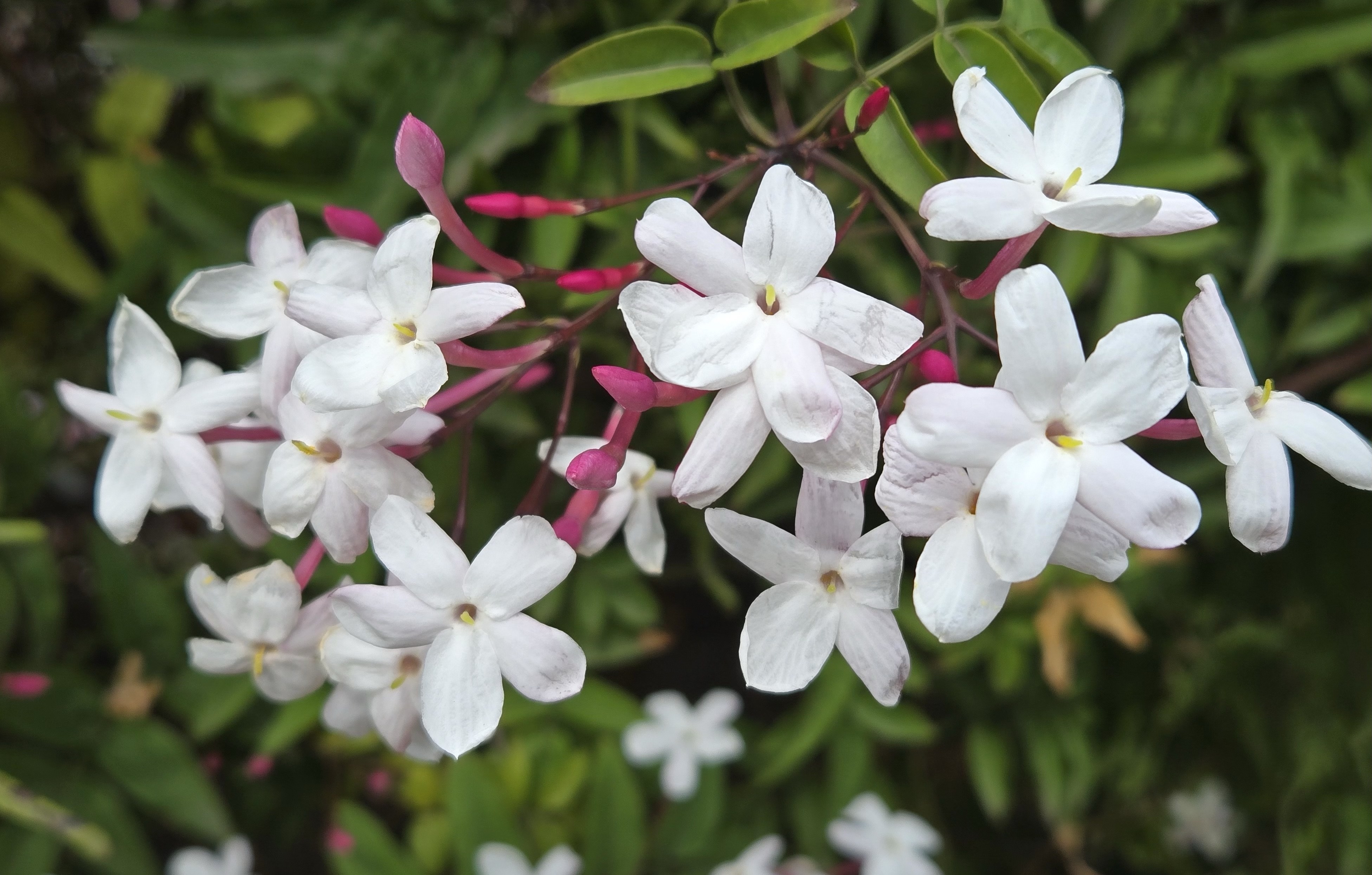
Jasmine
Let me start with this flower. During the visit, strolling through the garden, I took in plenty of visual beauty — peonies, chrysanthemums, and irises were all gorgeous.
Later I walked into the indoor museum, which had displays of Chinese herbs, plant specimens, fossils, and so on.
The museum had many windows opening onto a terrace. At the far end of the terrace, a fragrance hit me, and I traced it to jasmine climbing the wall. This was one of the most memorable flowers of the visit — its scent stood out. Also, the olfactory competition isn’t that fierce. Perhaps it’s just the season — wintersweet in early spring is also quite fragrant, as I noted in my essay from Langya Terrace.
Jasmine, Jasminum grandiflorum. Wikipedia lists several alternate names: Spanish jasmine, royal jasmine, Catalan jasmine; this flower is also recorded in the Yongle Encyclopedia
Jasmine comes from Guangzhou. Transplanted from the Western Regions, it does not change with the soil. Legend has it that Suxin was the name of a woman who died of longing, and this flower grew on her grave, its fragrance clinging to clothes and not easily fading. South of Guangzhou city lies a flower field, where Liu Yan of the Southern Han buried a beauty. This variety is abundant there; locals weave the flowers into festive lanterns, quite charming in their own way.
Lingnan Fengwu Ji (Records of Lingnan Scenery)
Yaximing and jasmine were both transplanted from the Western Regions to the South China Sea by foreign peoples. Southerners, charmed by their fragrance, competed to plant them. Lu Jia’s Nanyue Xingji says: in the land of Nanyue, the five grains have no flavor and the hundred flowers have no scent. These two flowers alone are fragrant, because they were transplanted from foreign lands and do not change with the soil — unlike the orange that becomes a trifoliate orange when moved north.
Jiao’s Category Forest
In folk legend, it sprouted from the grave of a palace maid named Suxin during the Five Dynasties and Ten Kingdoms period, in the Southern Han court. The Southern Song poet Fu Bocheng drew on this legend in his verse:
昔日云鬟锁翠屏,只今烟冢伴荒城。香魂断续无人问,空有幽花独擅名。
(Once her cloud-dark hair locked the emerald screen; now a smoke-mound keeps her company in the ruined city. Her fragrant spirit, lingering unasked after — only the quiet flower still owns its name.)
The scientific account is that it spread from the Western Regions to Guangzhou, where it was widely planted for its outstanding fragrance. In Persian, it’s called Yāsamin. When it entered ancient China through the Western Regions, the name was transliterated as “耶悉茗” (Yēxīmíng). In modern naming, it’s often given the meaning “gift from God”[1]Yasmin is a girl’s name of Persian origin, meaning “jasmine flower.” This word derives from yâsamin, meaning “gift from God.” The national flower of the Philippines, this plant is native to warm, tropical regions of the world. Blossoming into a delicate flower with soft yet crisp petals, her namesake can inspire baby Yasmin through its gentle beauty. Like the flower that blooms in many colors, Yasmin can express herself through the vibrancy that sets her personality apart from the rest. Yasmin - Baby Name Meaning, Origin and Popularity
As for the flower itself — it’s not cold-hardy, so growing it settled in the north would be difficult.
Iris
Like jasmine, let’s start with the origin of the name. Iris, scientific name Iris.
In Greek mythology, Iris is the goddess of the rainbow. She served as a messenger between the gods and mortals, conveying the will of Zeus and other deities, while also guiding the souls of the virtuous across the rainbow bridge to the heavens. It’s likely because of the iris’s diverse colors that the ancient Greeks named it after the rainbow goddess. The Chinese name, 鸢尾 (yuānwěi), comes from the petals resembling the spread tail of a kite (a type of raptor).
After entering the garden and passing through the fern exhibit, the first flower I saw was the Japanese iris / butterfly flower / Iris japonica . Later I found it just about everywhere in the garden.
I didn’t recognize it at first. It looked pretty, and out of curiosity, I used AI image recognition to identify it. 🙏 Thanks to technological progress, or I’d have remained one of those who still haven’t learned the name of the flower they saw that day.
The butterfly flower is native to the region south of the Yangtze River in China and to Japan. Its petals are quite intricate, consisting of:
- Outer perianth lobes: The three large outer petals that droop downward, white with striking orange-yellow nectar guides[2]Nectar guide — patterns on petals that serve as a “landing runway” and “navigation map” for pollinators like bees. The vivid colors and special patterns clearly guide insects to the nectary and pollen deep inside the flower, efficiently completing the pollination process. A clever evolutionary strategy. and pale purple wash — the most recognizable feature of the butterfly flower.
- Inner perianth lobes: The three upright petals at the center, paler in color, light purple or white with slightly wavy edges, slender in form.
- Reproductive structures: At the center, you can see thin white filament-like structures — the combination of stamens and pistils. The anthers at the top of the stamens are typically yellow, while the pistil’s stigma sits at the very top of the flower, uniquely shaped.
I don’t have the expertise for a more detailed introduction yet, but I found a solid article: Getting to Know Irises, Starting with the Most Common Butterfly Flower and Its Lookalikes
Related Cultural Works
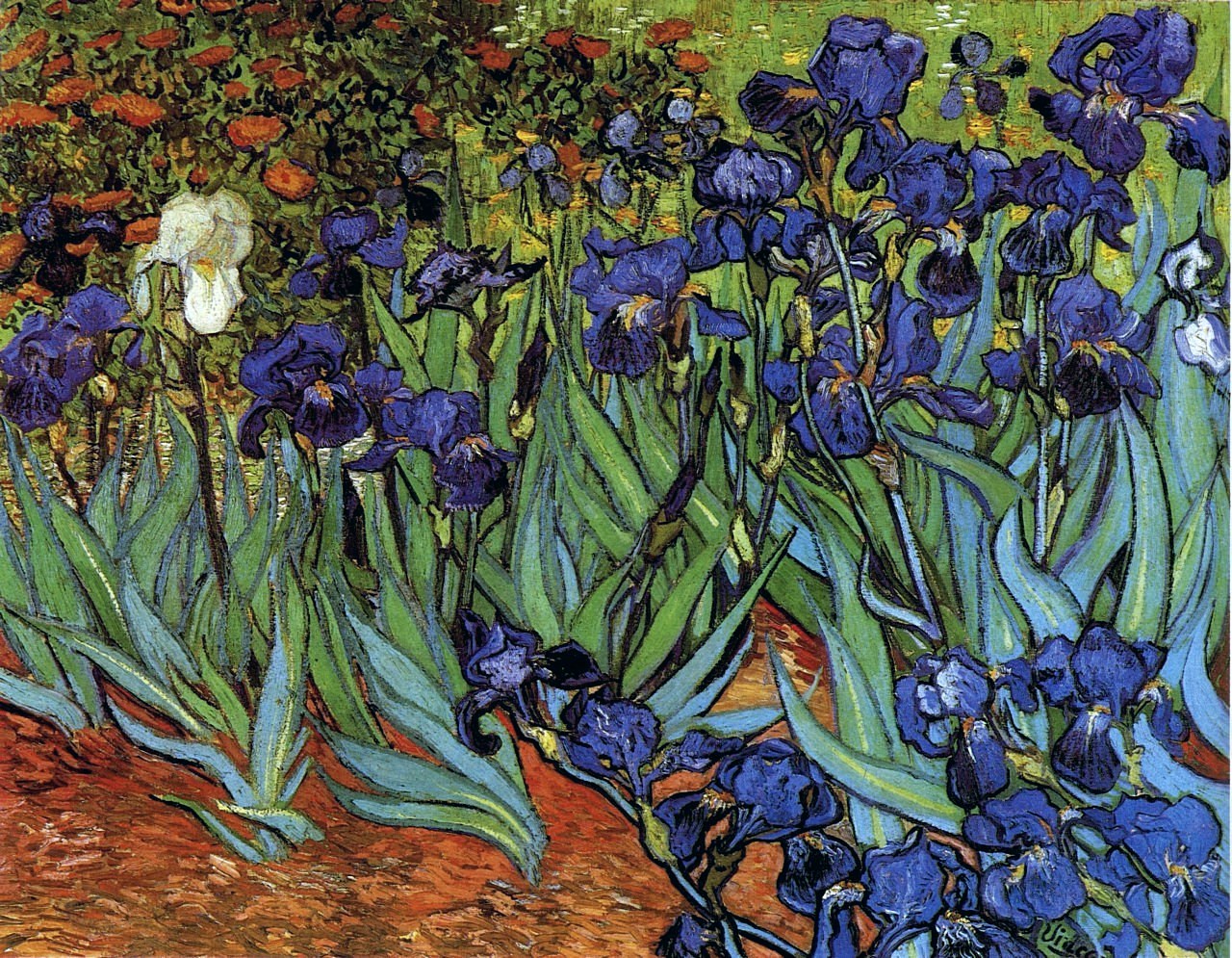
Van Gogh painted Irises in 1889.
You can also find it in a song I’ve been listening to lately:
你听 远处传来阵阵
滚滚
低沉的雷声
我们依旧不愿离开
直到雨点打在了肩上
狂风咆哮着
卷起尘土骤然打进眼帘
禁不住放慢了脚步
没有人说话
默默传递香烟
分享苦茶
分享远处鸢尾花任性的绽放No One Can Get Closer to Each Other Than Us, Sound Toy
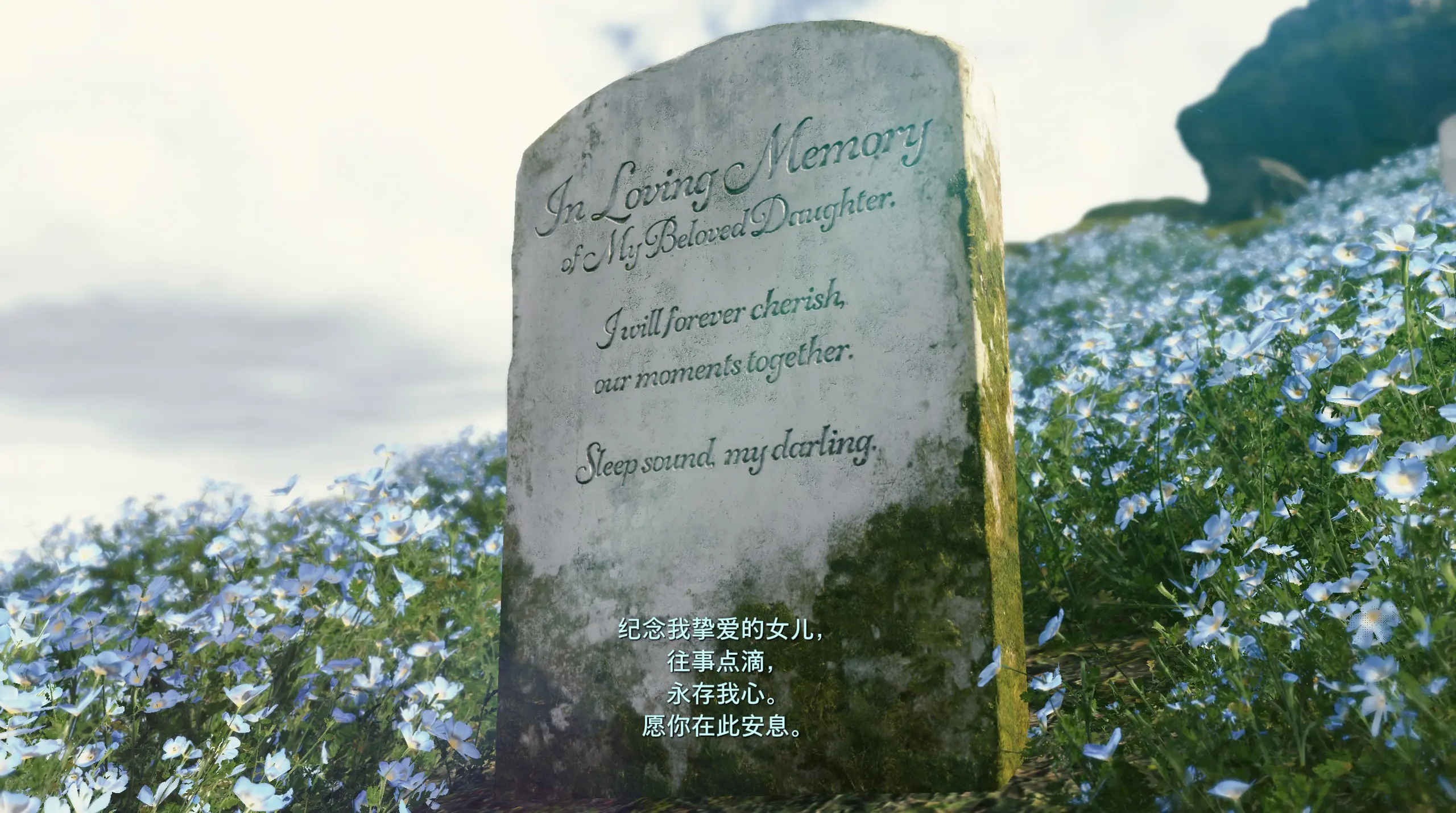
In Death Stranding Director’s Cut, blue-and-white wildflowers cover the ground in the cemetery near the Ruins Factory. The color matches the butterfly flower.
The wildflower is called Blue Bird Flower, sharing the same abbreviation as Bridge Baby. In some Native American traditions, the bluebird totem is seen as a symbol of hope, love, and rebirth, heralding the arrival of spring.
Strawflower
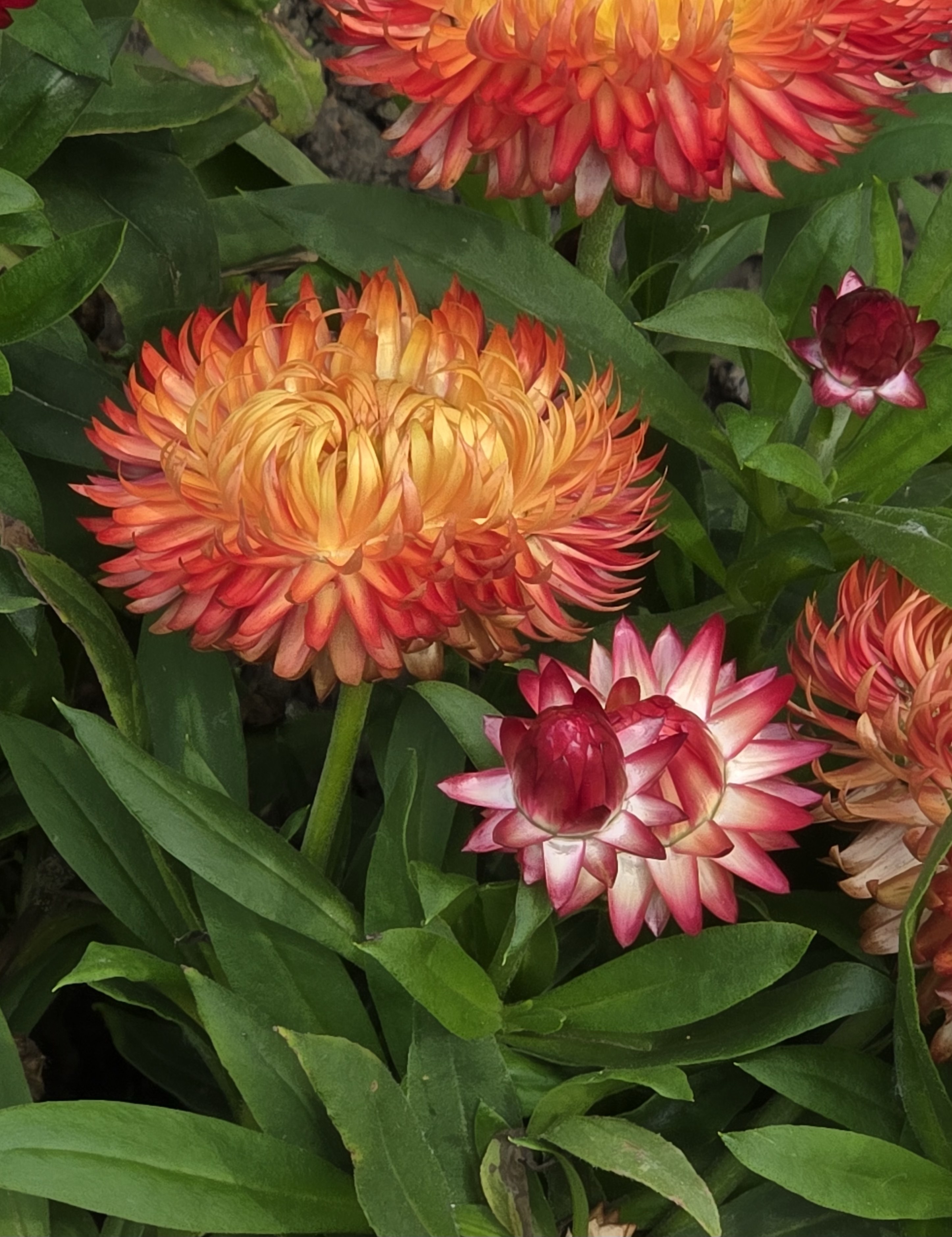
Strawflower, scientific name Xerochrysum bracteatum, also called eternal flower, native to Australia. Named because its petals are dry and stiff, like straw — they don’t wither even when dried, and are often used for dried flower arrangements.
When fully open, the color is striking, somewhat like the small sun heater I used to use at home.
Flower Carousel
2026-04-03: Too lazy, will add later. The image ratios are inconsistent, making it awkward to dump them all into one carousel component. Also I don’t recognize some of the flowers — need to identify them before adding captions.
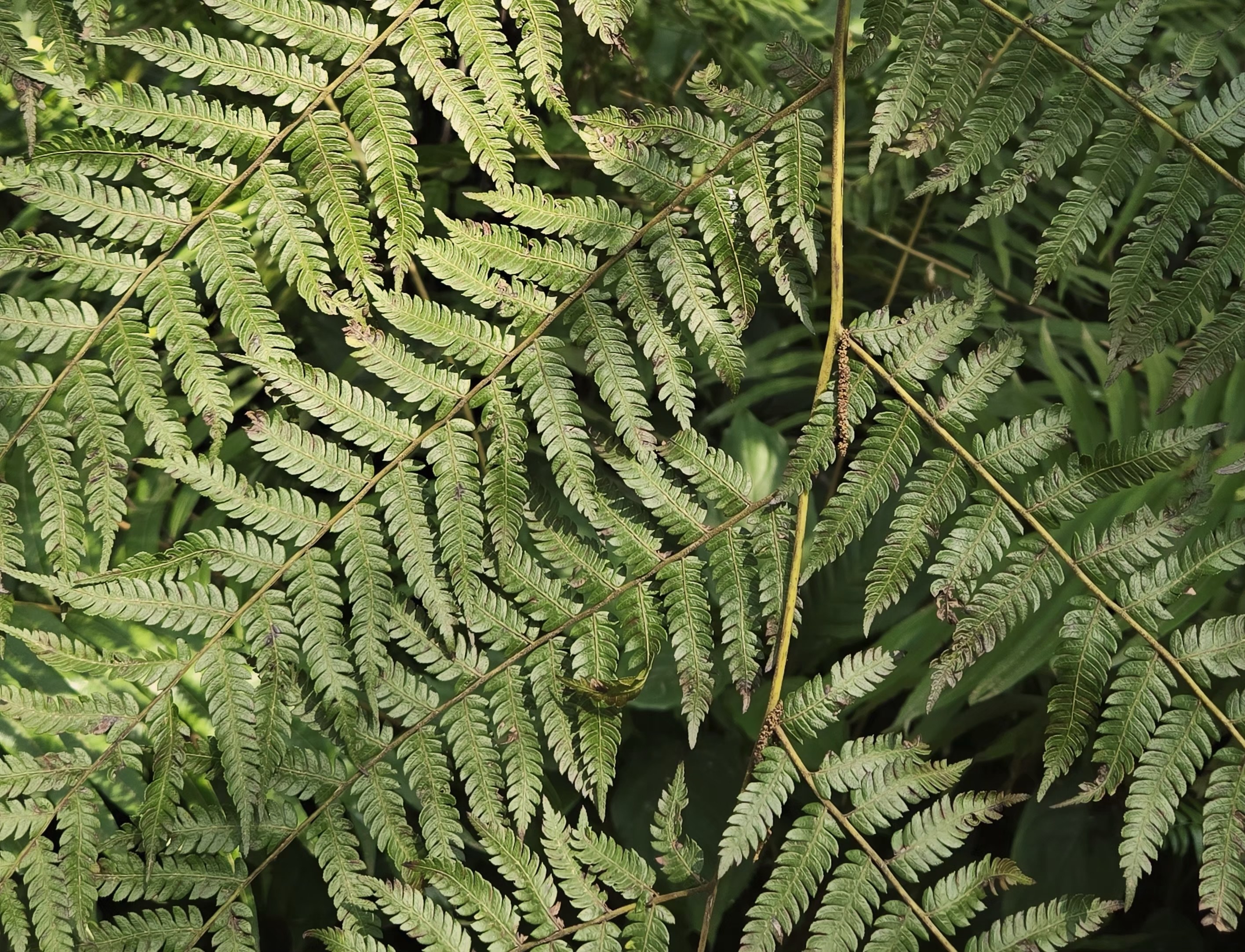
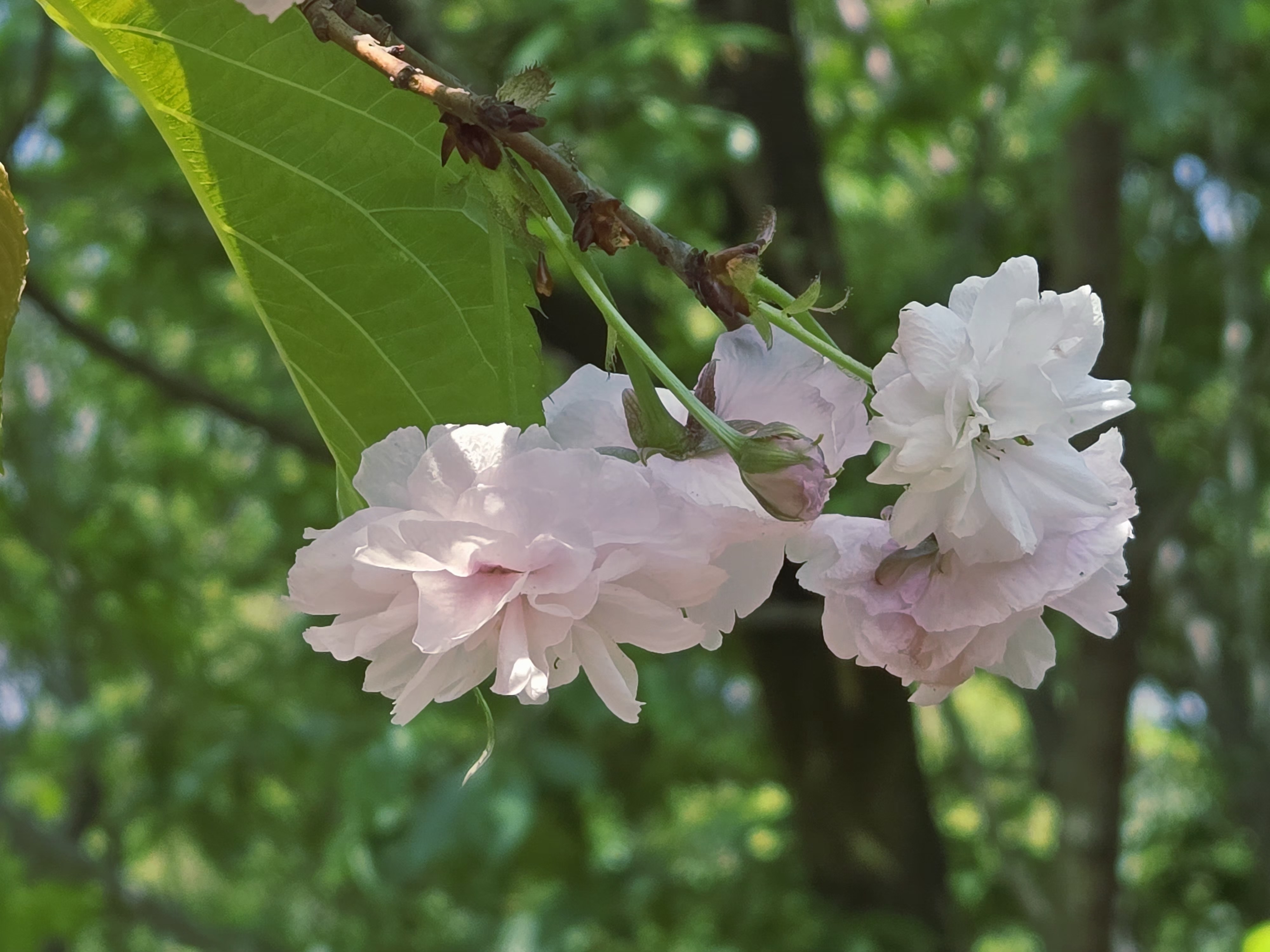
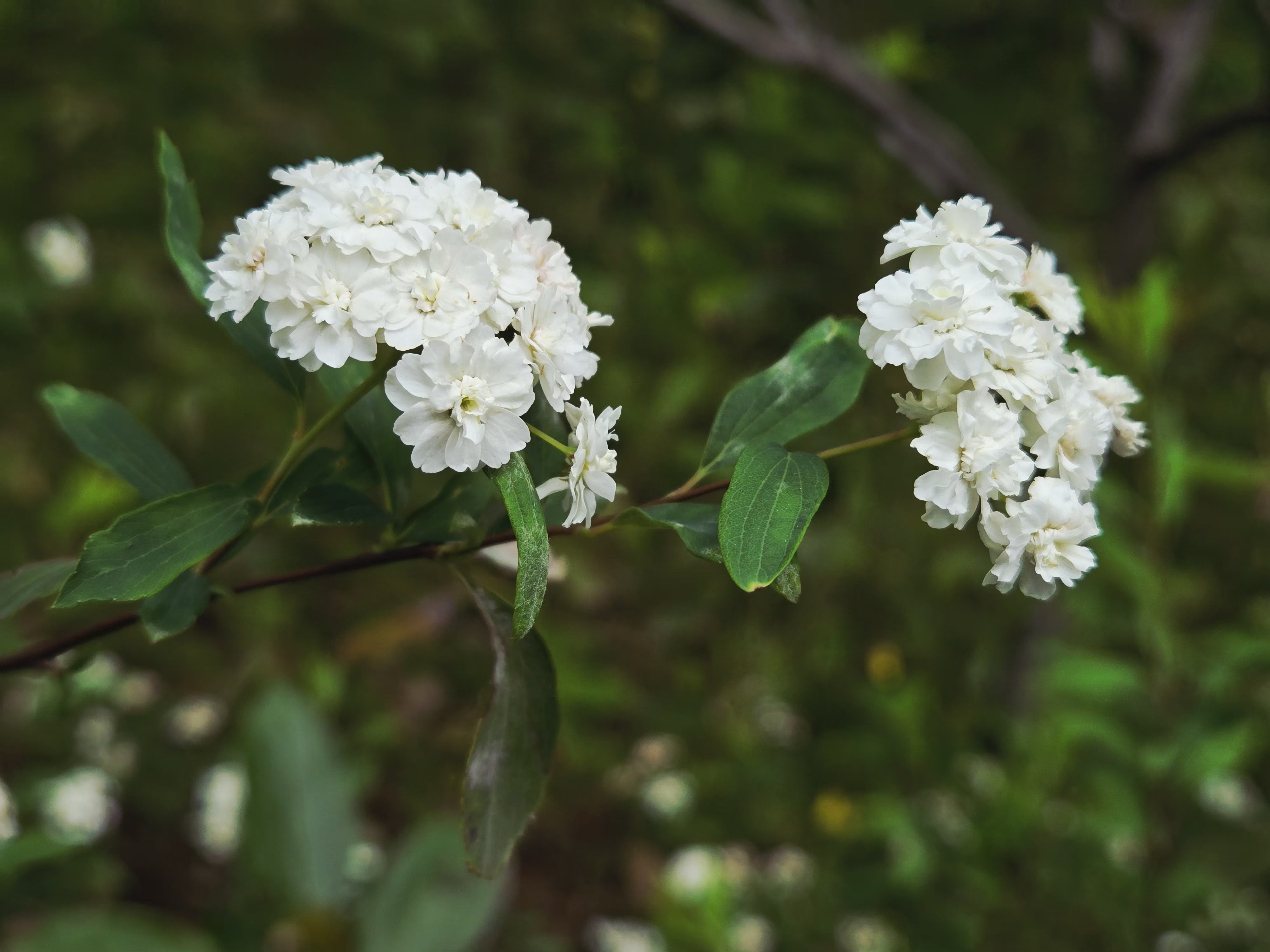
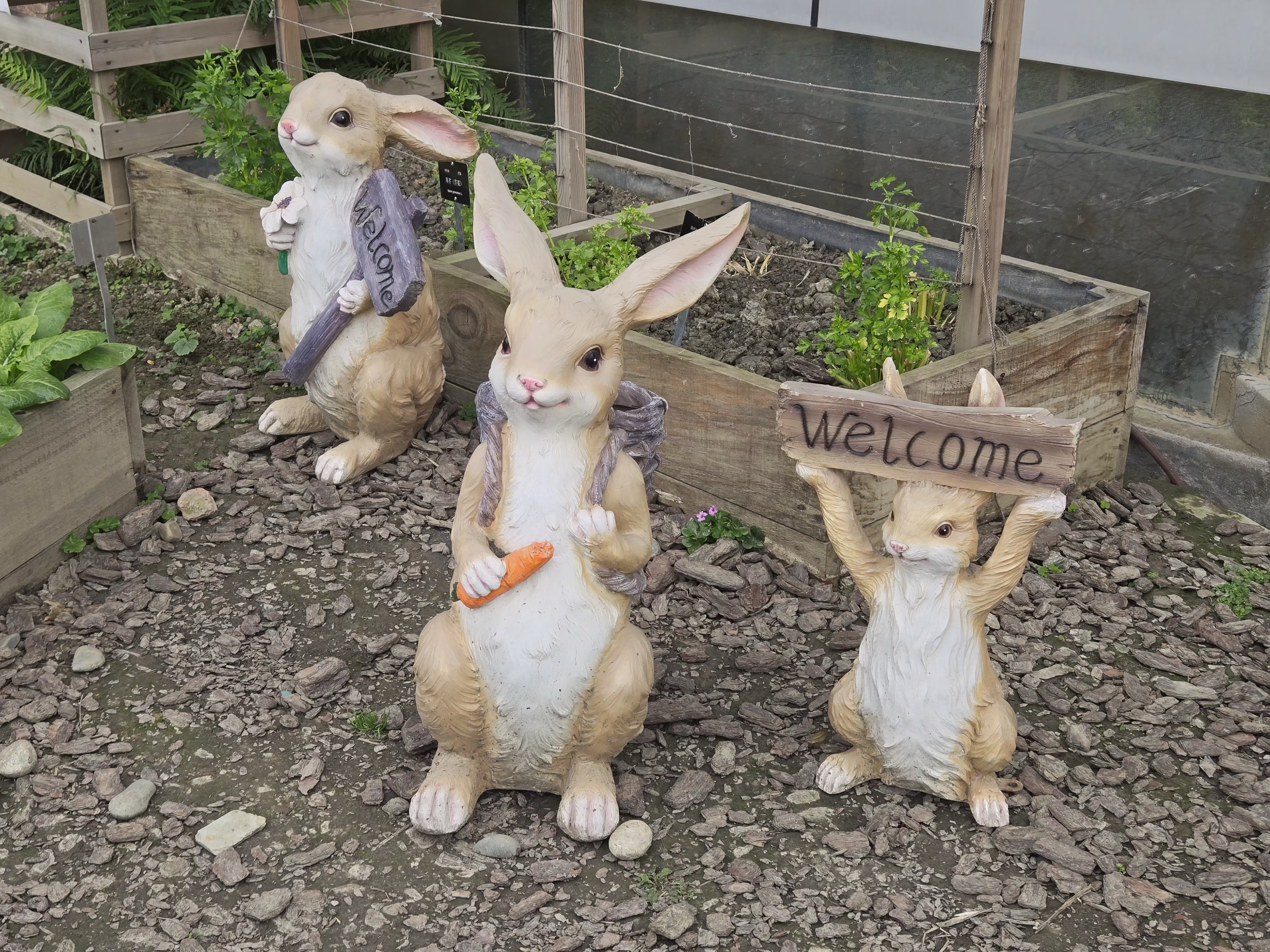
2026-04-08: Added four photos — ferns, cherry blossoms at the garden, Guangzhou spiraea, and a rabbit sculpture on the museum terrace.
Regarding the cherry blossoms, there’s a rather absurd incident worth recording: A woman at Shanghai Gucun Park climbed a tree for a photo and broke the cherry tree
At the Chengdu Botanical Garden, plenty of people were also climbing trees for photos, despite the “No Climbing” signs. Let’s be civilized park visitors 🤝🏻
Outro
On my way out, I passed through the back-hill ecological forest and couldn’t resist exploring a bit — though my phone battery was getting dire. Later, near the plaza vendors, I bought a power bank voucher on Meituan to keep it alive.
There were also some empty milk cartons left around. My standards should probably drop to match — but I’m a germaphobe and didn’t want to pick them up. Maybe next time I’ll bring a plastic bag for collection, though with this many people around I probably won’t bother 🫠
Walking from the plaza to the back hill, I ran into an auntie running with a kite string, trying to get the kite moving for her kid to see 🪁 After coming back down to the plaza area, I discovered a new batch of kids: sitting in a row on benches, some painting watercolors, some doodling on parasols… Today was Wednesday — looked it up and it turns out elementary schoolers are on spring break. Pretty sweet 🥰
Reminds me of my high school days (a pavlovian response kicks in). My high school ran on monthly leave — a comedy of shrinking holidays. If we ranked holidays from best to worst: 4-day work weeks > weekends > alternating long/short weekends > single day off > monthly leave (roughly one day off every two weeks).
During my sophomore year, the “Double Reduction” joke[3]The “Double Reduction” policy is a basic education reform introduced in China in July 2021, aiming to reduce the burden of homework and off-campus tutoring for students in compulsory education. It was a major policy decision by the Party Central Committee and the State Council, fundamentally intended to push schools toward faster quality and balance, improve classroom teaching, reform assessment systems, and promote the overall transformation of basic education for students’ well-rounded development. was the dark humor we savored most between classes. Legal holidays? Still a shell game of cancellations, just not entirely wiped out. But it did bring us the grand synthesis of assignments[4]Synthesize Big Watermelon (合成大西瓜) is an online mini-game by the brand Weisan Games under Beijing Midou Technology, officially released on January 22, 2021..
This Chinese New Year, while strolling by the beach with old friends, I heard that the experimental track at my old school had classes starting on the fourth day of the lunar new year. Man, what kind of canned schedule is that.
Anyway, I’m starting to sound like a “cyber-town-cryer.” But the happiness of a proper spring break — that’s what life should look like.
Yasmin is a girl’s name of Persian origin, meaning “jasmine flower.” This word derives from yâsamin, meaning “gift from God.” The national flower of the Philippines, this plant is native to warm, tropical regions of the world. Blossoming into a delicate flower with soft yet crisp petals, her namesake can inspire baby Yasmin through its gentle beauty. Like the flower that blooms in many colors, Yasmin can express herself through the vibrancy that sets her personality apart from the rest. Yasmin - Baby Name Meaning, Origin and Popularity ↩︎
Nectar guide — patterns on petals that serve as a “landing runway” and “navigation map” for pollinators like bees. The vivid colors and special patterns clearly guide insects to the nectary and pollen deep inside the flower, efficiently completing the pollination process. A clever evolutionary strategy. ↩︎
The “Double Reduction” policy is a basic education reform introduced in China in July 2021, aiming to reduce the burden of homework and off-campus tutoring for students in compulsory education. It was a major policy decision by the Party Central Committee and the State Council, fundamentally intended to push schools toward faster quality and balance, improve classroom teaching, reform assessment systems, and promote the overall transformation of basic education for students’ well-rounded development. ↩︎
Synthesize Big Watermelon (合成大西瓜) is an online mini-game by the brand Weisan Games under Beijing Midou Technology, officially released on January 22, 2021. ↩︎