In those years I rode west through Brocade City, once drunk on plum blossoms as if sunk in mud.
For twenty li the fragrance never broke, from Qingyang Palace to Huanhua Creek.Lu You · “Quatrain on Plum Blossoms”
On June 11, I walked a route similar to Lu You’s, from Qingyang Palace to Huanhua Creek, though today the two places are only one or two kilometers apart.
Continuing from the previous post, I will keep recording what I saw inside the park.
Hui Garden
Entering from the east gate, I had only walked a few steps before hearing birdsong throughout the park. I do not know many birds, but the call of the spotted dove is very familiar. It is common in the city, and there are many videos about it online, so I had learned a little about its calls and habits. When I lived in Xinyuan dormitory, that “gu-gu-gu” sound downstairs at five or six in the morning was it, like a wake-up call reminding me that I had stayed up through another night .
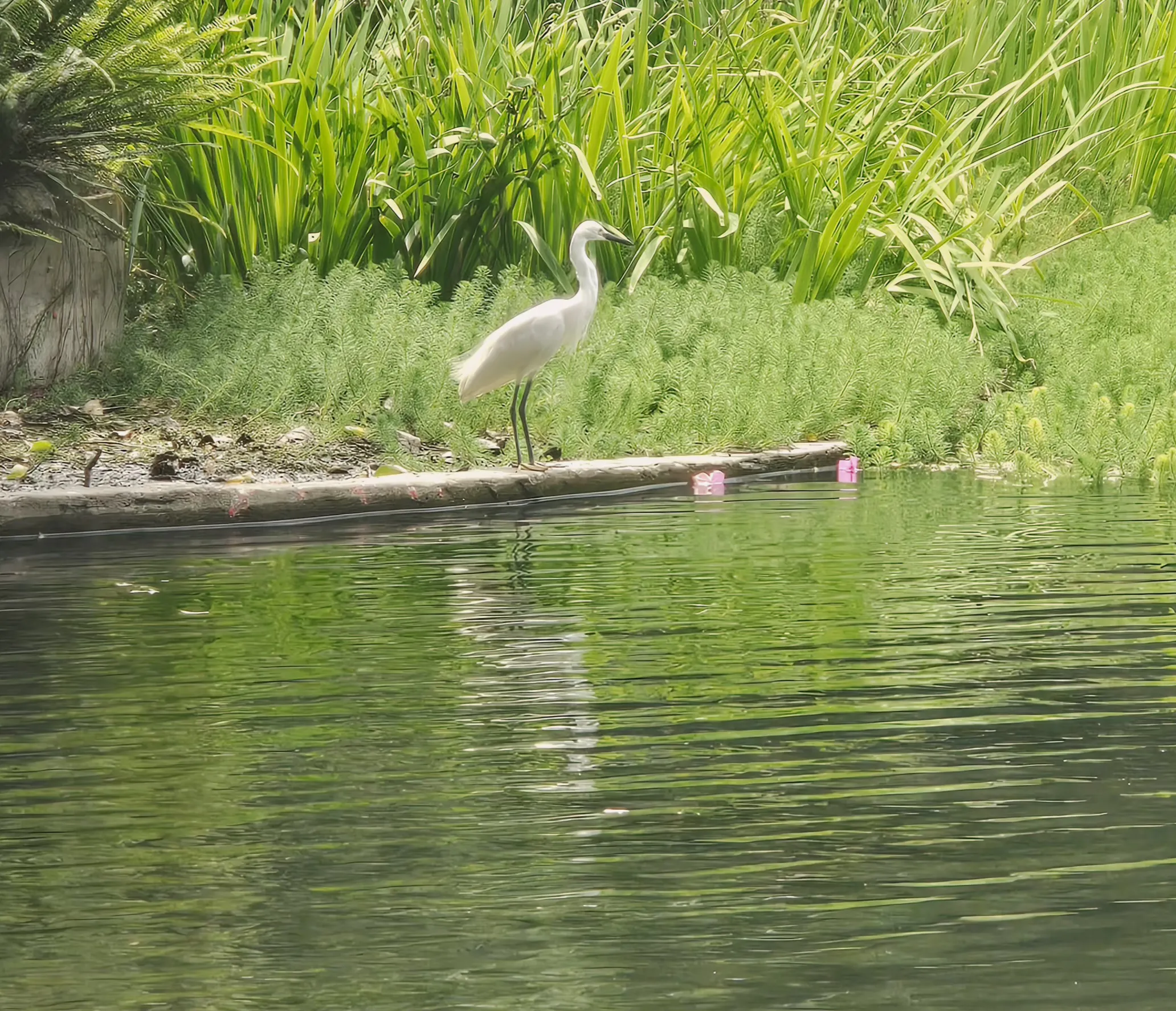
Many kinds of birds live in the park, each with its own place: sparrows shuttle through branches, white-cheeked laughingthrushes[1]“Tu huamei” refers to the white-cheeked laughingthrush. There is a video on Bilibili recording its growth from hatching to adulthood. move through low shrubs, egrets “wait by the water for bait” near the wetlands, and spotted doves usually pick up grains and crumbs dropped by visitors on the ground.
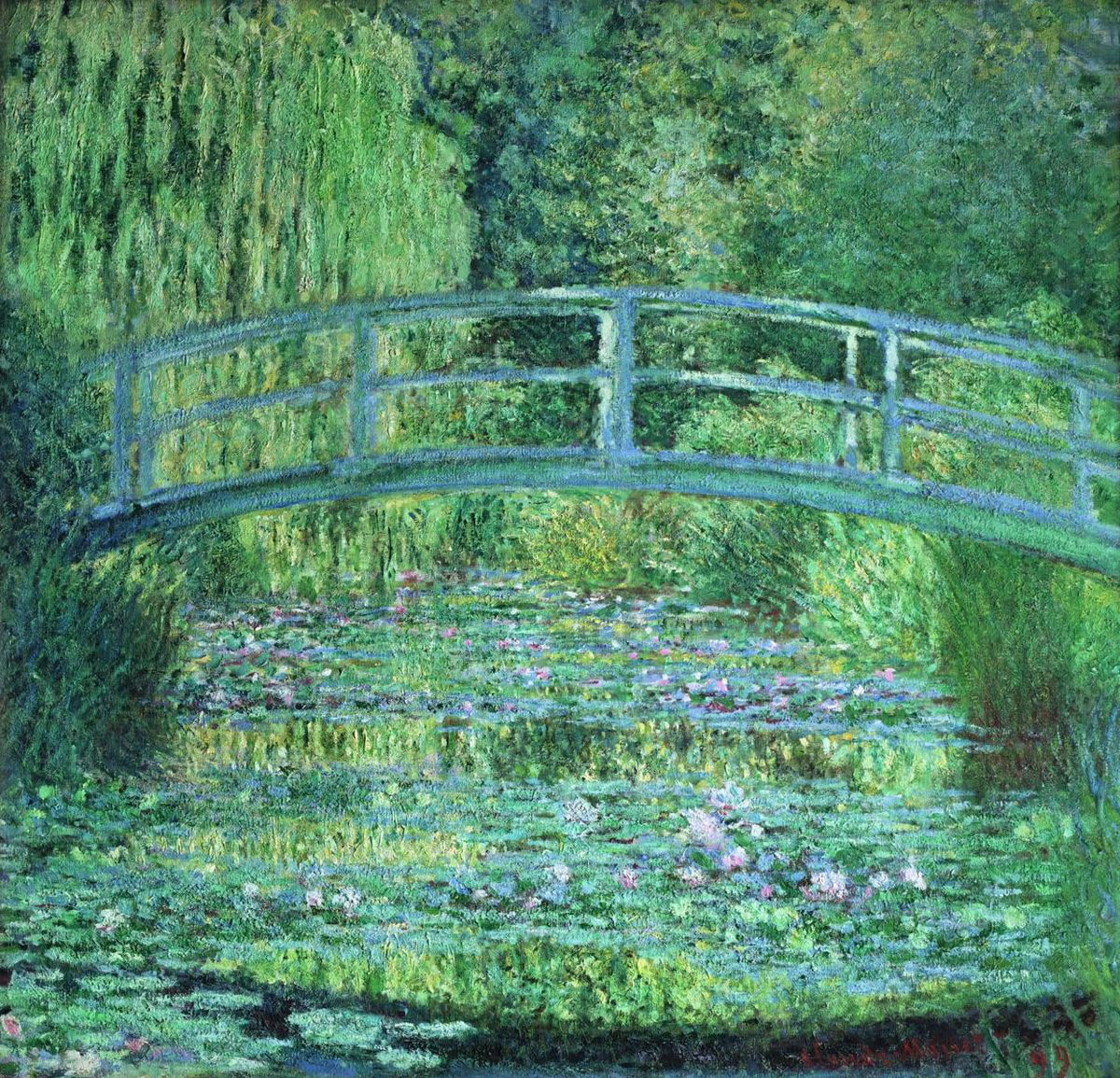
After walking a few dozen steps, I reached Wanxiang Tower. The whole area was still under repair. A water-treatment notice stood by the water, but it did not say what exactly was being treated. The water surface was covered with aquatic plants, dotted with tiny white flowers like scattered stars. It looked very much like the waterscape at Egret Island in Du Fu Thatched Cottage, which reminded me of Monet’s water lily pond, though the aquatic plants were far less elegant than water lilies.
I looked it up later. The plant on site seemed to be elodea.
Beside the path was a shop called “N Degree 8 Music Restaurant & Bar,” which seemed to be closed.
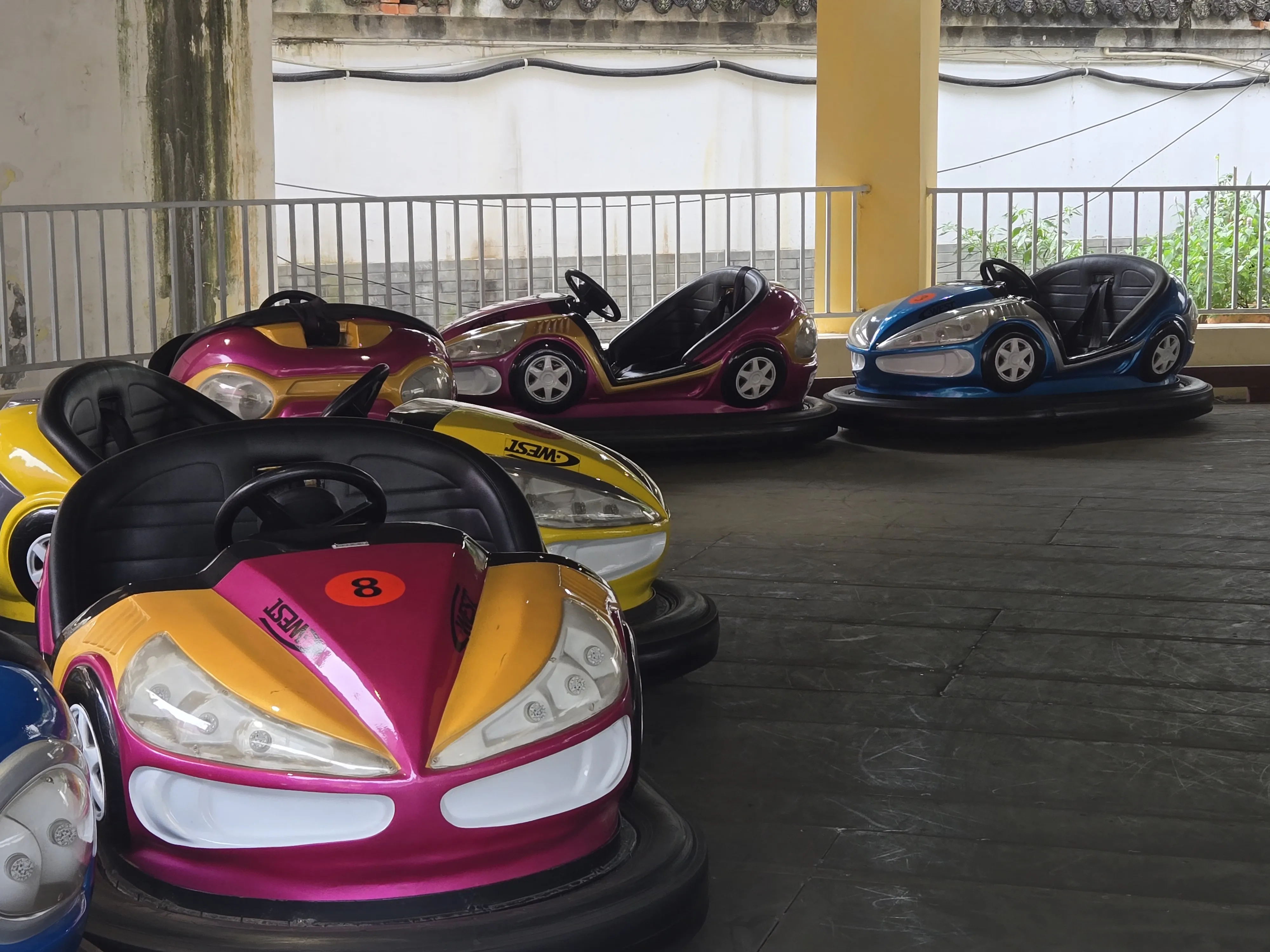
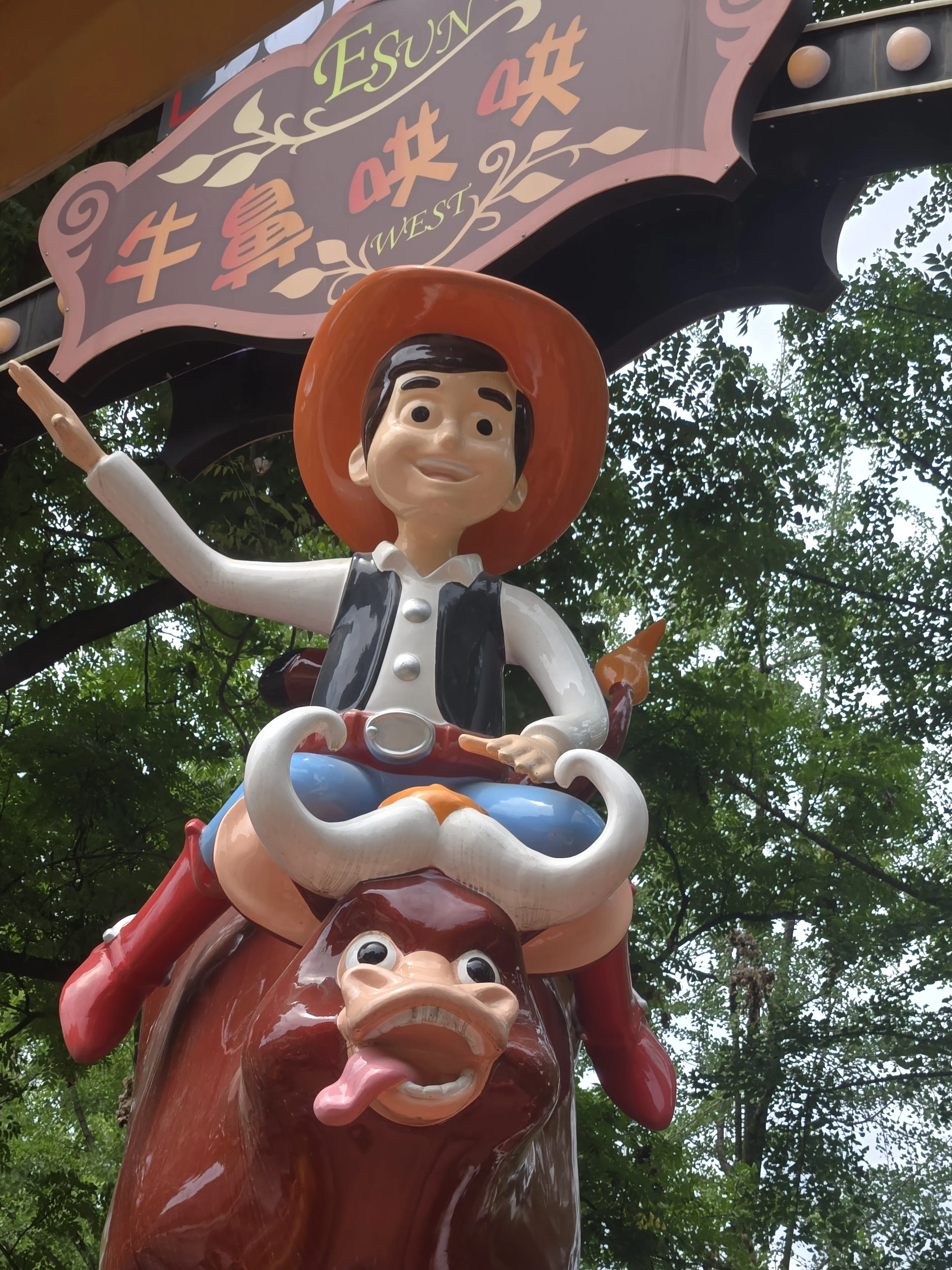
The amusement area ahead was quiet and deserted. The bumper cars and pirate ship had no visitors. Only one milking-cow toy was plugged in and occasionally mooed. It was boring, but at least no real cow had to work. Beside it was a small goldfish-scooping stall, probably with a hundred red goldfish, but it too was empty: no tourists and no stall owner.
Lei Garden
After passing through the amusement area, I arrived at Lei Garden. At 15:11, I found a bench to rest and cool down.
Lei Garden was built after Nuorilang Waterfall and Five-Color Pond in Jiuzhaigou. Before me were a ten-meter-tall artificial hill and waterfall, cycads common in Chengdu, and lotus flowers in full summer bloom. In the distance, inheritors of Sichuan opera intangible cultural heritage were filming a promotional video, rehearsing repeatedly in one spot and then moving to another after a take passed.
While I rested, they were still filming on the flat bridge by the lotus pond, the kind that reveals a new scene with every step. An old father was being dragged forward by his daughter. The daughter wanted to go closer to watch; the father said they could see it from nearby too.
I took out my computer and recorded what I had seen, leaving material for a future travel essay. Chengdu’s summer this year has been fairly mild. At this time last year I was still in Suzhou, and the June heat was already hard to bear. In my eyes, Suzhou is unbearable in summer, which has a lot to do with my own experience: in July I nearly collapsed from the heat while visiting the Lingering Garden, and when I went from my Xiangcheng rental to Suzhou North Railway Station, I had to stop several times along the way because it was so hot, though carrying too much weight also played a role. Chengdu’s highest temperature in May did not exceed 35°C, and in early June only three days exceeded 35°C. Judging from the data, it is actually similar to Suzhou.
Occasionally a few gusts of wind swept away the heat all over me. I thought of a line I had noted down two days earlier while reading Yeats’s The Wind Among the Reeds:
The winds awaken, the leaves whirl round
风已醒来,树叶微旋The Hosting of the Sidhe
How I wish the wind would often wake up when I am outdoors in summer. When I visited Xinglong Lake in May, sweat soaked my trousers and short sleeves, and the few gusts of wind near sunset restored me to life.
I walked over to the artificial hill and entered the cave. The summer heat retreated as soon as I went in. The cave was very cool. The rock walls and low ceiling were grey-white and rugged, shaped like stalactites. An LED light strip ran along one side of the path, winding close to the ground and shining on the wet stone slabs underfoot. As I walked, I encountered several large openings where light from the lotus pond outside came through. Water droplets occasionally fell from the top of the openings, landing coolly on my body. This cave was genuinely well built, with a kind of mini Water Curtain Cave feeling.
After seeing it, I returned to the pavilion and found that the father and daughter had also come over to watch Sichuan opera. There were Sichuan opera masks of Sun Wukong and a panda. The little girl shook hands with the panda once, and her parents encouraged her to shake hands with Sun Wukong too, but she was too shy.
Sichuan-style Bonsai Garden
When visiting gardens in Suzhou, I never understood the categories of Taihu rocks: wrinkled, leaky, thin, and transparent. Traditional Chinese bonsai is similar, so in the Sichuan-style Bonsai Garden I only gave things a quick look.
There is a pavilion in the garden. The pond in front of it has already dried up, and a stone stele beside the pavilion reads “Ancient Baihuatan.” The stele was erected by Huang Yunhu in the late Qing. When he searched for Chengdu’s historical sites, he identified this pool in front of the pavilion as the ancient Baihuatan. That judgment may not be accurate.[2]For investigation of the old site, see Yang Ruoxu’s article 【历史文化】寻找浣花溪 百花潭和杜甫草堂旧址.
Baihuatan as a place name appears at least as early as the Tang dynasty. Du Fu wrote in his Chengdu thatched cottage, “West of Wanli Bridge stands a thatched cottage; the waters of Baihua Pond are my Canglang.” The cottage, Wanli Bridge, and Baihuatan echo one another in the poem, forming one coherent scene.
When Baihuatan is mentioned, people often also mention Lady Ren of Huanhua. She was born beside Huanhua Creek and later became a concubine of Cui Ning, military governor of Xichuan. In the third year of Dali, 768, Cui Ning went to court, and Yang Zilin, prefect of Luzhou, took the opportunity to attack Chengdu. Lady Ren spent her family wealth, recruited brave men, and personally led troops in a counterattack. In the end she repelled the rebels and preserved Chengdu, so she was granted the title Lady of Ji.
Later, people built flower pavilions and shrines beside Huanhua Creek to commemorate her. That shrine is today’s Huanhua Shrine[3]For Huanhua Shrine, see this relatively careful article from Sichuan Provincial Gazetteer. inside Du Fu Thatched Cottage, also called the Shrine of Lady Ji.
There is also a folk legend: when she was young, she once washed the cassock of a monk suffering from sores, and flowers immediately floated up in the creek. The name “Huanhua,” washing flowers, thus gained an almost supernatural explanation.
Leaving the Park
I wandered along the park’s greenway and finally left through the west gate.
When Lu You wrote of Qingyang Palace to Huanhua Creek, fragrance continued for twenty li. Today this stretch is only one or two kilometers, and half a day was enough to walk it. There were no plum blossoms along the way, but the park’s birdsong, lotus flowers, Sichuan opera drums and gongs, and that dried-up ancient pond came together into another kind of twenty li.
Notes
Baihuatan also has free Wi-Fi, which is quite nice. My phone battery was stretched thin, so it came in handy.
Baihuatan Introduction Video
“Tu huamei” refers to the white-cheeked laughingthrush. There is a video on Bilibili recording its growth from hatching to adulthood. ↩︎
For investigation of the old site, see Yang Ruoxu’s article 【历史文化】寻找浣花溪 百花潭和杜甫草堂旧址. ↩︎
For Huanhua Shrine, see this relatively careful article from Sichuan Provincial Gazetteer. ↩︎